
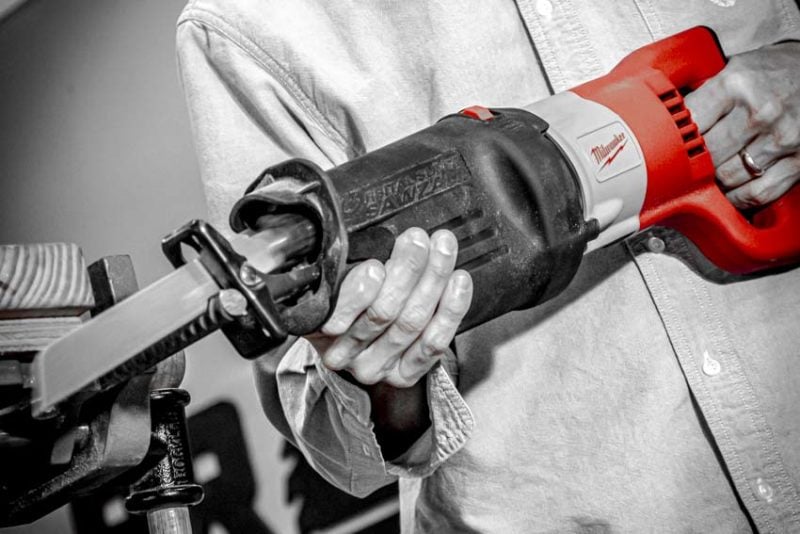
Now, you might think choosing the best SawZall blade for any job would be incredibly easy. Just select bi-metal or carbide (among the various carbides). Then, decide how long the blade needs to be. Pick from 3, 5, 7, 10, 14, 18, or 24 TPI configurations. Decide whether to prioritize cutting metal (thick or thin), wood, nail-embedded wood, PVC, shingles, or even roots. Lastly, ponder how many blades it might take and buy enough so you don’t have to run back to the store. After all that, run the math to balance all those considerations so you stay within your budget.
Then again, perhaps selecting the best SawZall blade takes a bit more thought…That’s OK. We’ve got you covered.
Editor’s Note: SawZall is the Milwaukee trademark name for a reciprocating saw. Thus, when we speak of the best SawZall blades, we mean the best Milwaukee-branded reciprocating saw blades.
Demystifying the Best SawZall Blade Options
If the above options seem confusing—you’re in good company. Add to that, the fact that new SawZall blade choices appear quite often. In fact, Milwaukee Tool is in the midst of a carbide-tooth Sawzall blade expansion right now.
To help clear things up, we recently spoke with Karl Weber, Milwaukee Tool’s Sawzall Blades Product Manager, about blade selection. He broke down the key considerations, setting us on the path to blade choice mastery.
Match the SawZall Blade to the Material
Choosing TPI (Teeth per Inch)
The foundation of blade selection centers around the material you intend to cut. The material determines the Teeth Per Inch (TPI) needed to cut efficiently. This also delivers the maximum blade life for that material. The rest of your blade selection choices should follow from TPI. Karl broke TPI down as follows:
- 3 TPI: Use for clean wood and roots
- 5 TPI: Designed for nail-embedded wood
- 6–11 TPI: Variable TPI for longer life on multi-material wood-embedded nails through metal
- 7–24 TPI: Use on metal (fewer TPI for thick metal, more TPI for thin metal)
Bi-metal or Carbide Teeth Blades
From here, you end up choosing between two large categories of blades: bi-metal or carbide. Less expensive bi-metal blades offer satisfactory performance in common applications. These “disposable blades” work well when you can get the job done quickly and you don’t want to spend a lot on a blade that may not make it to the next job. You may, however, need to use several of these blades for tougher cuts.

Bi-metal SawZall blade Carbide SawZall blade
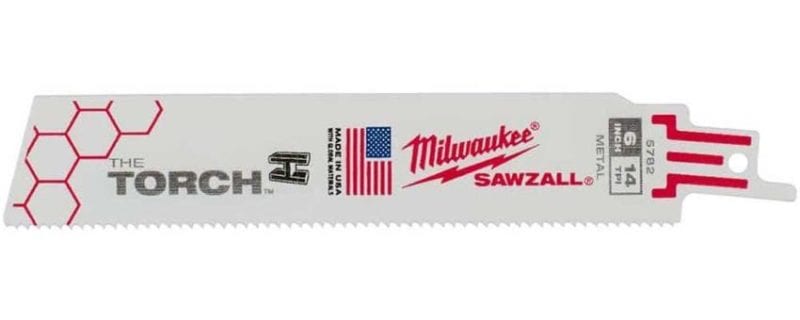
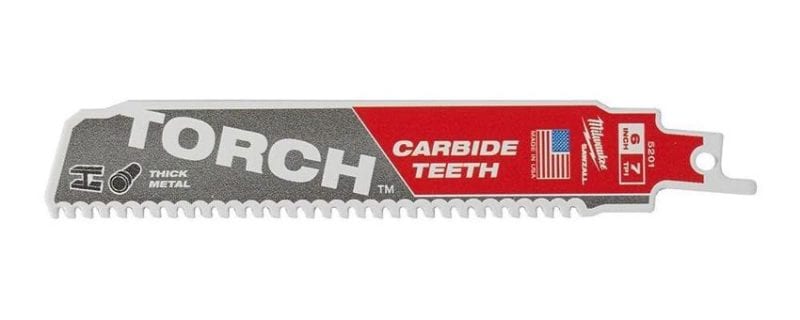
Carbide tooth blades offer professionals more cutting options, improved efficiency, and potentially lower accessory costs. That last part may be hard to swallow without some math. After all, you’ve been to the store. Those carbide blades cost a LOT more than the equivalent bi-metal.
That math actually works out…
If you or someone on your crew has ever attempted a cut that burned up 15 or 20 bi-metal blades—that’s $30 to $40 (at least). It also translates into half an hour or more of lost labor time. That may be an extreme example, but you get the idea. In many cases, the right carbide blade saves time and money.
Benefits of Using Carbide SawZall Blades
Clearly, Milwaukee Tool has a vested interest in promoting carbide SawZall blades. In our own experience—regardless of brand—carbide blades generally result in increased productivity.
That’s money.
Carbide blades also offer cut through more materials than bi-metal can handle. Take stainless steel for instance—don’t tackle that with bi-metal. When you combine faster cutting with significantly longer blade life, carbide starts to make a lot of sense. Why buy 3-5 blades, when one will do the job—and possibly the next job as well?
Best Milwaukee Carbide SawZall Blades for Wood
Milwaukee carbide blades have been available since 2016. However, in addition to original models, the lineup has introduced several new models. We expect the line to continue evolving over time.
Ax with Carbide Teeth for Pruning and Clean Wood Blade

We recommend one-handed reciprocating saws for pruning as they offer an easier way to cut low-hanging branches than chainsaws, pole saws, or hand saws. The Ax with Carbide Teeth for Pruning and Clean Wood blade perfects the accessory for this application with a durable solution for hardwood that clears material quickly and stays sharp. This 3 TPI blade practically devours wood as it cuts, making it our best SawZall blade for pruning.
Ax with Carbide Teeth for Nail-embedded Wood Blade
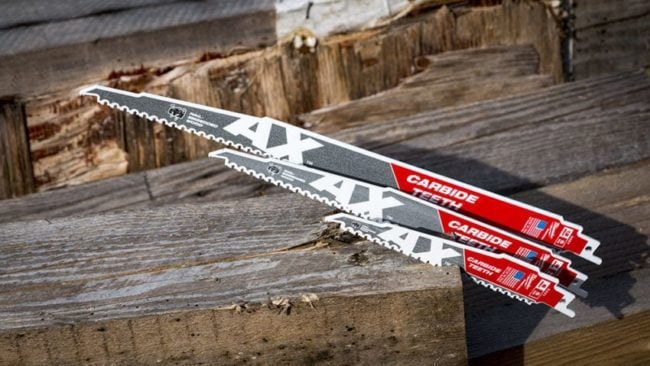
The original Carbide Ax blade works really well for cutting through nail- or screw-embedded wood, shingles, plaster, or even Durock. This blade delivers a ton more life than any bi-metal blade—letting you cut longer before having to swap out for a new accessory. That alone makes it our pick for best SawZall blade for nail-embedded wood. Part of that arises from the use of a nail-guard design that keeps larger nails from getting in between the 5 TPI teeth and snapping off carbide bits. Instead, the blade glides over the nails and screws as it cuts.
Best Sawzall Blade for Demo
Wrecker with Carbide Teeth for Multi-Material Cutting
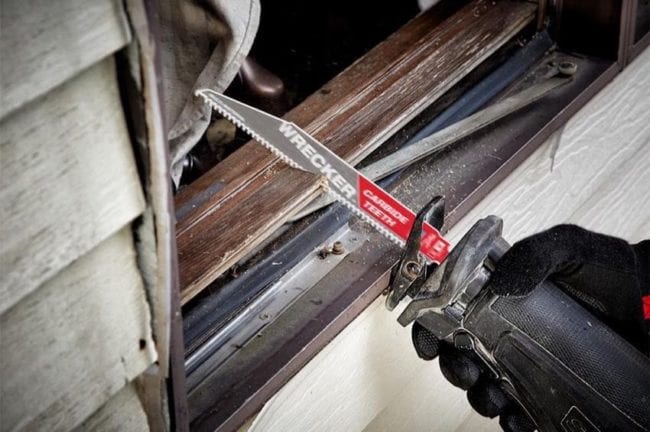
The best carbide SawZall blade for demo work uses an agressive 6 TPI design. It lets you cut through a wide variety of materials. This blade not only tackles clean wood quickly—it can take on cast iron. Of course, that’s not our first choice for this blade, but in a pinch… This blade should be your go-to when doing demolition jobs that could reveal any number of materials needing to be cut away and removed. It even manages to keep the Milwaukee “Fang Tip” for plunge cuts into wood. The design stays close to the Ax design, but the increased TPI lets it transition into metal-cutting as needed.
Best SawZall Blade for Thick Metal
Torch with Carbide for Thick Metal
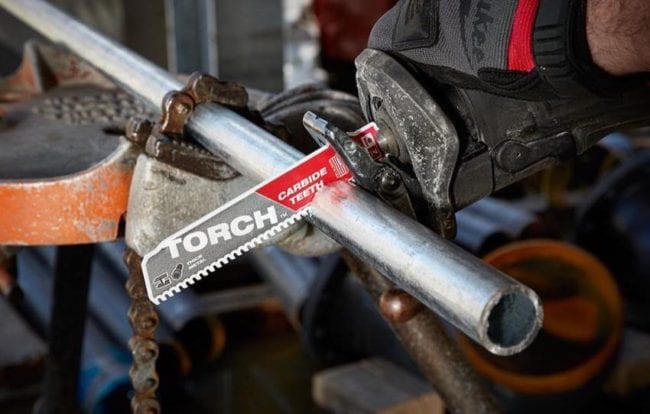
The 7 TPI Carbide Torch blade is best for thick metal cutting applications. It offers a good balance of performance and value. This blade optimizes cutting performance for black pipe, cast iron, angle iron, and even stainless steel without being quite as expensive as blades dedicated to those extreme cutting applications (see the Nitrus Carbide blade below).
Best SawZall Blade for Cast Iron or Soil Pipe
Torch with Nitrus Carbide
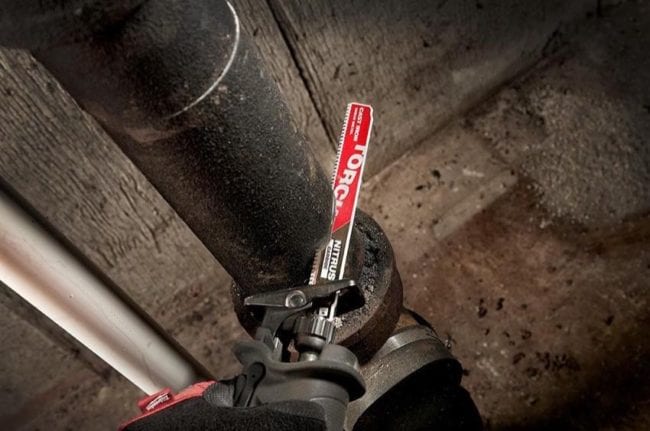
A truly unique and specialized solution, the Milwaukee Torch with Nitrus Carbide thick metal blade uses next-gen carbide teeth. It competes directly with other traditional carbide teeth reciprocating saw blades. The idea is to spend a bit more to maintain both accessory life and speed of cut. These 7 TPI blades last several times longer than Milwaukee’s existing carbide teeth reciprocating saw blades. They do it by reducing heat during cutting. The blades contain 25% more Nitrus Carbide per tooth, making them the best SawZall blade for cutting cast iron and soil pipe over and over again.
How Blade Height and Speed Affect Cutting
We’ve been asked how blade height and speed affect the cut. It presents a valid point since so many blades vary in height and thickness. Although these characteristics aren’t as important to blade selection as TPI and blade material choice, they do contribute to practical cutting speed.
Common 1-inch tall blades are more rigid and durable. Although shorter blades are more flexible for flush cuts, they don’t have the same stability. They also won’t last as long.
Regarding speed, you typically want to slow down when cutting thick metals and stainless steel. Heat is always the enemy of blade and tooth life. With that said, Milwaukee knows most folks simply pull the trigger and go…
Because of this, they test all of their blades at full throttle. It ensures an overzealous worker doesn’t necessarily burn up a blade faster than its stated life by going full tilt!
Choosing the Right SawZall Blade Length
Once you’ve chosen the appropriate TPI and blade material, what blade length is appropriate? Karl explains that you should choose a blade at least three inches longer than the material’s diameter/width for wood blades. For cutting thick metal – especially pipe with an inner and outer wall, opt for a blade at least four inches longer than the diameter/width for safety. By the end of 2020, each of Milwaukee’s five carbide blades will be available in 6-, 9-, and 12-inch lengths.
In closing, choosing the best SawZall blade doesn’t have to be a mystery.
It might just save you loads of labor and money over time.


Great article. Perhaps you can assist on my hunt for the elusive best blade to cut the devil of all trees – desert Juniper. I’ve tried lower teeth per inch, higher teeth per inch, thicker blades, thinner blades, longer blades, shorter blades japanese pruning blades, none are clear winners. And this is 4 years of experimenting. Juniper is hard as a rock with a very high silica content and Janka rating of 680lbf. Chain saw blades need sharpened after about every 8 cuts to keep going well. No thanks. I haven’t given up on a magical sawzall blade that can handle Satan’s evergreen wrath. I’m tempted to say that demolition blades for both wood and nails have performed ‘best’ – though Junipers kills anything that touches it, fast. I’ve tried carbide D***** blades at 2-3tpi – awful, tried about every name brand out there and plenty of overseas blades. Spraying silicone on the blades ‘helps’ but Juniper will smoke out and quickly erase all pretty paint on a new blade. Any thoughts?
That sounds like a beast of a species to cut! I don’t have any first-hand experience with desert juniper, but based on what you’ve said and what I could dig up, I’d definitely lean into carbide blades. I’d start with Milwaukee’s Nitrus Carbide Wrecker (48-00-5273). It’s a 6 TPI with advanced carbide that should have a long life, even with that high silica content.
If that doesn’t work, I’d try Milwaukee’s Nitrus Carbide Torch (48-00-5263). It’s an 8 TPI blade designed for cast iron. The tooth geometry isn’t as aggressive as the Wrecker’s, but it might make for smoother progress.
Unfortunately, they’re not inexpensive, but if one of them ends up working well for you, they’ll be worth the price.
I’m not sure what saw you’re using, but there are a couple of things to consider on the tool. One is the stroke length. The best models have a 1.25-inch stroke length, so they’re removing more material with each stroke and engaging more teeth to spread the work out.
Also, you might try cutting at a slower speed. It can seem counterintuitive, but cutting slower helps reduce heat build-up and reduces vibration, which can actually increase the speed of the cut from start to finish. It’s a little trick we learned from cutting stainless steel.
Let us know what ends up working!
Hey thanks for the quick reply! I’m interested in this Milwaukie Nitrus, Carbide Torch, maybe it’s the ‘torch’ portion along with ‘iron’ that’s got me hopeful.
It makes sense the ‘smoother’ as I have carbide blades but with lower tpi and they snag, hang up/jump. I work with a variety of sawzalls – corded and uncorded – MIlwaukie, Dewalt, Makita for corded, uncorded is Ryobi for far out in the field. I try to feather speed in first cut approach and ongoing but will pay closer attention with each type blade to narrow this down scientifically as much as possible, I’ll try this Torch for cast iron first and report back. Perhaps this comment thread can help someone else out there.
My sense is that ‘metal’ cutting is the way to go, I just need to find a long enough blade to adapt that to trees. Fires can and do start from sparks/heat using a chainsaw hitting particularly high silicate content trees. Not kidding, Very old Junipers are also known to gobble up whatever they grow around and it’s not unheard of to find things ’embedded’ deep in the trunk or from hollowed out holes now closed over within the trunk where old-timer sheepherders and ranchers placed cast iron cooking skillets etc., some people have even found old 6 shooters or long guns lol. I’ve got some ‘pioneer’ Juniper trees that are easily 400- 500 years old – as long as they’re healthy, those stay.
Spent a nice evening reading on this site, lots of great content! Got a wish list together on new innovative tools, this is a fabulous resource online.
Glad we could help!
That’s fascinating info about those old Junipers. Thanks for sharing!