
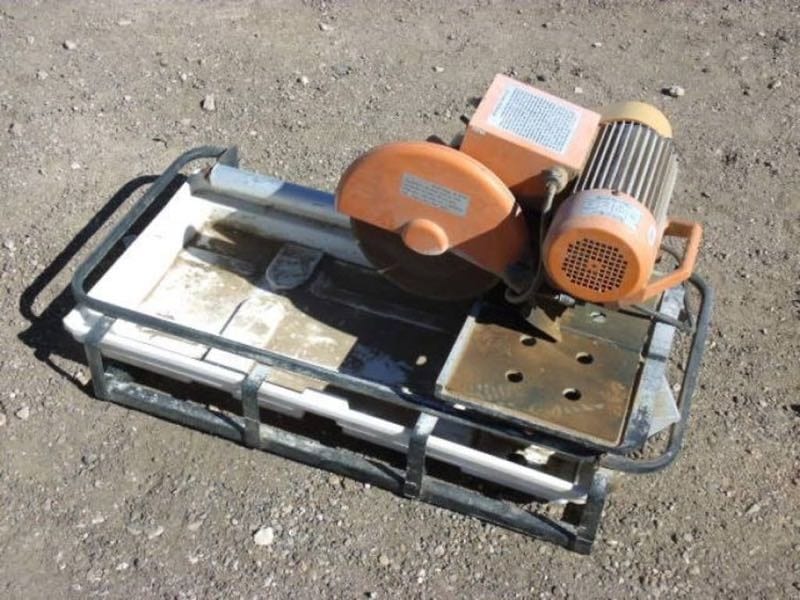
If you’ve ever taken on (if you’re a professional) or thought about taking on (if you’re a DIY-er) a large tiling job, then you know how amazing a large capacity wet saw can be in helping you get the job done quickly. While I know plenty of people who swear by smaller saws, straight edge cutters, and even diamond-bladed angle grinders, a wet saw like the Chicago Electric tile saw is often a must-have tool when dealing with denser tile like porcelain, which is traditionally harder to cut through than standard ceramic tile.
Ah, porcelain tile. Rugged. Dense. And we had just over 250 square feet of it to install… mostly on the walls… and half of it in a diamond pattern… with chair rail and decorative inserts. This was not a time to try out a wimpy saw particularly when you consider the density of porcelain vs ceramic tile. For this job, we chose a 2.5 HP 10-inch wet saw from Chicago Electric Power Tools. Chicago Electric is sold almost exclusively through Harbor Freight – a name that will bring to mind visions of bargain-priced inexpensive Chinese tools in some. In others, the thought will drift to how long their no-name tools will last. In either case, we were able to pick up this 10-inch behemoth tile saw for less than $200 – not a bad deal if you’ve done any shopping around for full-sized tile saws like the Bosch TC10 Tile Saw.
Chicago Electric Tile Saw Build Quality
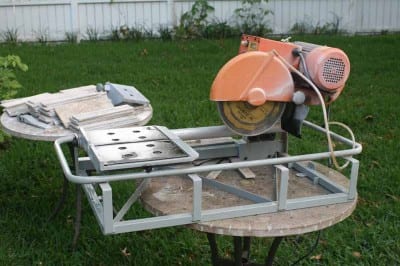
The Chicago Electric Power Tools 10″ Tile Saw is actually a pretty rugged saw. It has a cast alloy body and two-position cutting head for handling both tile and masonry up to 3.75″ in thickness. The frame is made of steel, with a squared-off welded base with plenty of supports and a tubular rim to which is attached the roller and sliding mechanism. It’s an extremely heavy device, weighing in at 140 pounds at the store. Since it doesn’t come with a stand, this thing is one heck of a load, even when you’re just porting it from a nearby shed to a table for cutting. We’d heartily recommend purchasing some kind of stand for the saw, preferably something with wheels. Chicago Electric Tools has a folding table stand with wheels, however a more robust third-party solutions might be better for long term use and storage.
Tile cutting is done by placing a tile on the rolling cutting tray and then sliding the tray towards the 10-inch diamond blade. Blades cost around $20 at Harbor Freight, but you’ll pay anywhere from $11 – $150 for a 10-inch blade at your local home improvement store. We’ll save the diamond blade shootout for another article. The rolling tray is built out of the same sturdy steel and has rubber pads on top to hold the tile securely in place and cushion it against vibrations during a cut.
Where the tray meets the steel frame there is a steel-on-steel guide system that allows the tray to slide along the left side. It’s important to keep the guide lubricated as there are no ball bearings or rollers on the hinge side to help the tray roll smoothly. On the opposite side is a single small roller, centrally located along the length of the tray which guides the right side along the tubular right-side rail. The composition of the tray and guide rail gets the job done, but it’s not very sophisticated.
Adequate Water Pumping
The included 3 gallon per minute water pump is actually pretty robust. You’d think it would present a problem over time with the filter clogging up, but the physical makeup of the pump is such that it merely keeps out large pieces of tile and introduces no other real filters to get clogged with diluted thin-set or other foreign materials. Over time we found that the pump got a tad weak and it actually worked best when plugged in separately and not via the 3A switched outlet located just off the power supply of the saw. This is the same pump I see powering all manner of lawn fountains in my neighborhood, so continued use isn’t a problem provided it’s able to get a continuous flow of water.
Chicago Electric Tile Saw Room for Improvement
We did note a couple of problems. One was that the clear hose that leads from the pump to the twin feeder tubes that douse the blade had a kink in it. It wasn’t completely blocking the water flow, but it was a permanent kink that wouldn’t come out over time. The second issue was that one of the metal water tubes used to direct water to the blade was off, causing the water stream to miss the blade. We used a flat head screwdriver to bend the tube back into position and do a better job of cooling down the point of contact where the blade meets the tile during a cut. There is a reason this is called a “wet saw.” If you don’t have enough water getting to the diamond blade at the point of contact, your tile can chip and shatter more easily and you won’t get a clean cut.
Included Accessories
The Chicago Electric tile saw comes with a straight edge guide as well as a 45-degree miter guide which will allow you to make corner cuts on chair rail as needed. The included tray is made of ABS plastic and comes with a rubber stop that is attached to the tray with a chain. It’s a relatively shallow tray, which isn’t a big deal except that you’ll want to make sure you’re on fairly level ground when using the saw or you won’t have enough water level to completely cover the water pump and cool the cutting surface of the blade. I did like how light the plastic container was and that the drain could easily be unstopped to allow for draining of the majority of the water into a 5 gallon bucket. After that it was a simple process of removing the tray and cleaning it off with a hose to ready it for the next day’s work.
Testing the Chicago Electric Wet Tile Saw
We really abused the heck out of this saw and used it for a variety of jobs, from simple ceramic tile to hard porcelain and even some brick cutting. One thing we never experienced was a lag in the motor or blade. No matter what we fed the saw, the blade never bogged down or lacked for power. That means that this saw is about as good as the blade you put in it. While we plan on testing diamond blades at a later date, the $20 one from Harbor Freight certainly got the job done, though we suspect a better blade might make cuts even easier and more precise (we did note a lot of chipping around the edges of our cuts – something that typically isn’t a problem with the type of tile we were installing).
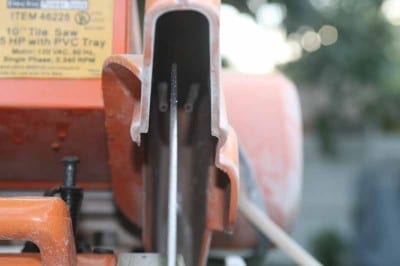
Blade changes were quick and easy. To change the blade, the metal guard lifts up to expose the 5/8″ arbor (incidentally this is also how you would access the metal tubes which feed water to the cutting area). To allow the 2.5 horsepower tile saw to quickly change blades, it features a spring-loaded blade lock that stops the blade from spinning while you use a wrench to loosen up the arbor and replace the diamond blade. It worked extremely well and you didn’t have to apply a lot of force to the spring-loaded activator to get the blade to stop. To the left of the power supply and blade stop, a metal cover surrounds the belt system that drives the blade axle. Replacing the belt is a simple function of removing the belt cover with two hex wrenches and accessing the drive system underneath.
Cuts Ceramic Tile Like Butter
Lighter ceramic tile the saw cut through pieces like butter. It also sliced through brick like it was made of play-dough. On harder porcelain products there was a much more controlled cut with some edge chipping and a need to slow down the speed with which we pushed the tile through to ensure we didn’t force it and crack the tile at the end of the cut. When pushing the tray through the cut there is a bit of friction and you really need to push from the left side where the hinge and guide assembly is located.
Pushing from the right seemed to bind the tray, even with ample amounts of WD-40 sprayed all over the guide system. To alleviate this, we recommend getting a hold of some lithium grease which sticks better and provides a bit more lubrication that won’t evaporate or wash away as easily as WD-40. The excessive binding is due to the lack of bearings and a guide which relies on distribution of friction across a large area of rounded steel piping. Overall it works, but it’s a tad clumsy and an area where more expensive products will show a marked improvement.
Using the Included Diamond Blade
The 10-inch diamond blade we were using, which we purchased at Harbor Freight with the saw, was a tad on the thick side, but even so did an adequate job of slicing though all sorts of tile. In cutting through porcelain in a diagonal pattern, we found that applying equal pressure to the tile and allowing the saw to cut through it gradually – without forcing the blade through – yielded the best results. In fact, we cut over 8 pieces of 12-inch tile directly down the center and not one broke off early or resulted in an edge that wasn’t cleanly completed.
By the way, if you’re looking to cut anything larger than 12-inch tile diagonally with this saw you’ll need to go somewhere else. One of the downsides with this saw vs. some of the more expensive competition is that many more expensive saws allow up to 18-inch tile to be cut on a diagonal. The water jets also did an excellent job of covering the blade and ensuring that the cutting path was completely cooled and that dust from the cut was kept to a minimum.
Cutting Thicker Porcelain Tile
We had some particularly thick porcelain tile from Florida Tile, a local supplier here in the state and the saw did an excellent job of slicing through it, though it was incredibly loud as it did so. On a given 12-inch porcelain tile cut we measured up to 120 dB SPL at 3 feet with our standard SPL meter – a level that, if sustained, could really do some damage. The saw was noticeably quieter with basic ceramic wall tile, just 110 dB SPL. Your ultimate noise output level is more a combination of the blade interacting with the tile at the rotational speed of the saw and not necessarily a negative, but it’s not a bad idea to consider hearing protection should you end up cutting into something that resonates equally loud – especially if you do this for a living.
Speaking of rotational speed, we tested the manufacturer’s specification of 3340 rpm and found it to be far less than the actual 3775 rpms we recorded with our laser tachometer. Of course, the saw did peak higher at start up (over 3800 rpms) and then settle down to a speed closer to the manufacturer’s spec when it began to bite into a piece of tile. On its own, the tile saw is rather quiet, measuring just 74dB SPL at 3 feet. While Harbor Freight has a lifetime warranty on all hand tools, its power tools (unless otherwise noted) have a standard 30-day money back and 90 day replacement warranty.
Conclusion
Overall the Chicago Electric Tile Saw packs a wallop. Its robust build quality, 10-inch diamond blade, and powerful 2.5 HP motor really powers through most jobs without even breaking a sweat. Some of the niceties, like an extended cutting tray, smoother rolling action, and better water delivery system might be found on competitor models – but at much higher prices. There’s also the issue of a short warranty – just 90 days and you’re on your own. Still, it’s hard to fault this saw, especially after using it on multiple jobs without any real difficulties.
This is one case where the inexpensive option has paid off and resulted in a very useful tool that has outperformed our expectations. Because of its ridiculously low price and excellent performance we felt it deserved a 9 on our value rating – especially since we’ve seen this tool with a street price of just $199. You’d be hard-pressed to find a decent 7-inch tile saw for that price. Overall, it’s hard not to make this a recommended tool. We think most professionals and do-it-yourselfers will find it to be an especially good bargain.