
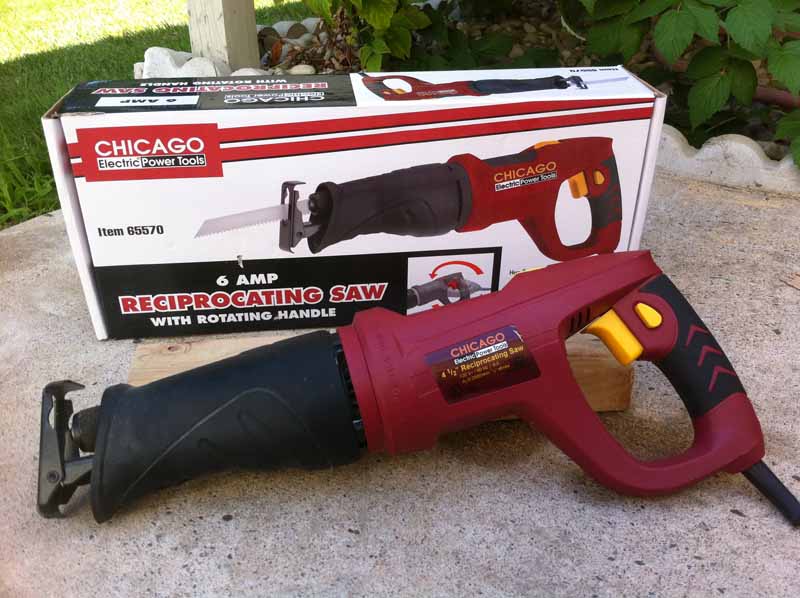
Everybody – and we mean everybody can use a cheap reciprocating saw to accomplish household maintenance and repair projects (well, OK, maybe not your mother-in-law). It’s just a super-convenient tool that lends itself well to being a multi-purpose “grab-it” solution. Harbor Freight’s Chicago Electric rotating handle reciprocating saw looks to be the cheapest product we’ve seen in some time, retailing for $25 and often being on sale for less than $20 (we know, that’s less than a combo pack of reciprocating saw blades).
We had wanted to review this product for some time and finally were able to procure one, on an out-of-town trip, no less. Never truly off the job, we latched onto the tool and opened up the box to begin our testing. Within, we quickly found the 6-amp 4-1/2″ reciprocating saw, a 10 tpi wood-cutting blade, a 24 tpi metal-cutting blade, and even a pair of replacement brushes. Lifting the saw from the box to feel how well it was made, our initial impression was that it was not exactly top-notch in the build quality department, but it did feel like a great occasional-use power tool.
Chicago Electric Rotating Handle Reciprocating Saw Build Quality
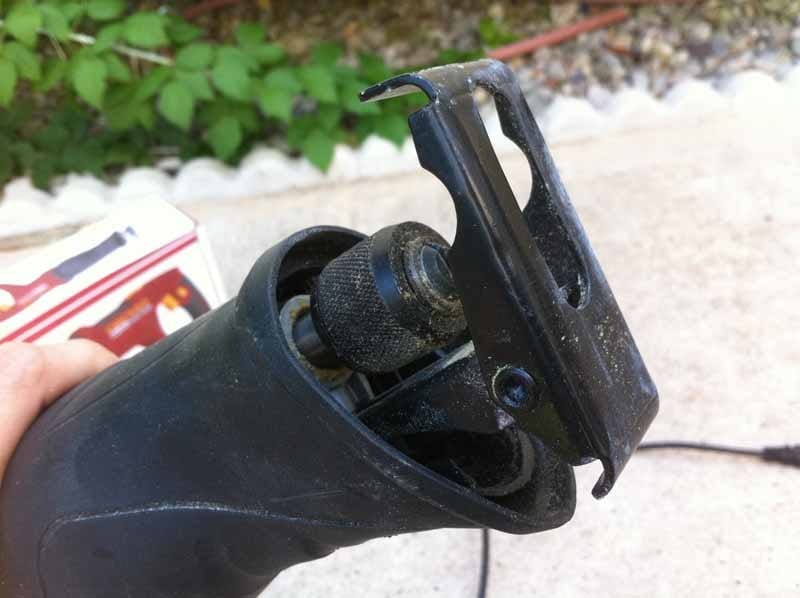
The very first thing we noticed with the Chicago Electric rotating handle reciprocating saw was that the pivoting shoe was a bit stiff. It actually pivots up to a full 30 degrees, which is rather nice, but it was really tough to get moving. Once we started using the tool and working it back and forth (and, um, after adding some lubricant!), it loosened up for easier use. We don’t want the shoe to be floppy, but I also don’t want it to keep me away from getting it flush to the workpiece, either.
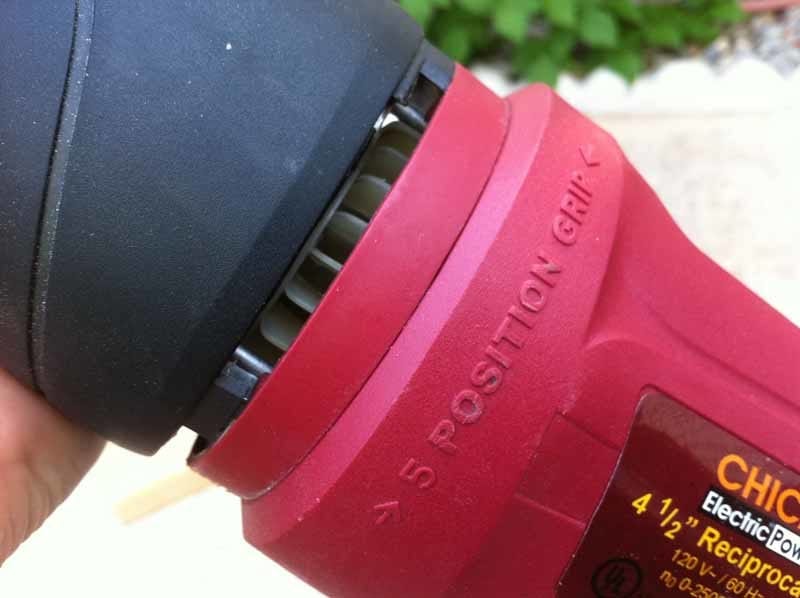
A big selling feature of the Chicago Electric rotating handle reciprocating saw is the rotating body. This really allows you to maintain a standard grip on the tool while performing horizontal, vertical, or even diagonal cuts. You can then complete your cuts without having to contort your forearms. It really makes the tool all that much more comfortable and ergonomic to use.
The motor brushes (the kit includes 2 replacements) are also easily accessible when the body is rotated 90 degrees to each side, and they are then visible through the top body cutout. The replacement brushes can be taken two ways, one is that the manufacturer is so sure that you will use your reciprocating saw for the rest of your life, you will eventually need to change them out. Or that it runs so rough that you will need the extra set during the initial warranty period if you use it too much.
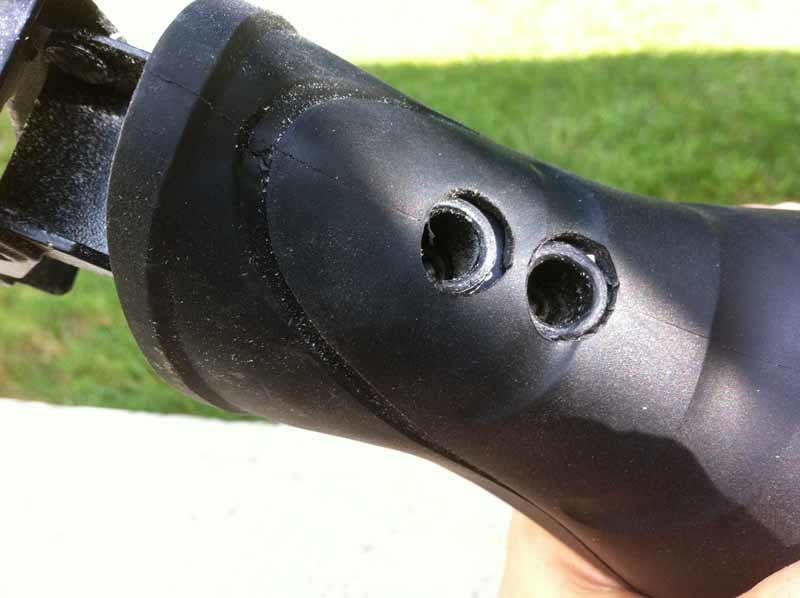
The rubberized overmold is easy to hold and quite comfortable, but it’s also not very grippy, particularly with ungloved and sweaty hands. This isn’t a huge deal, but we do like some texture on our grips, and this one is almost completely smooth. At the base of the front grip are Allen-type bolts that can be removed to allow access to the internal mechanism and removal of the shoe assembly.
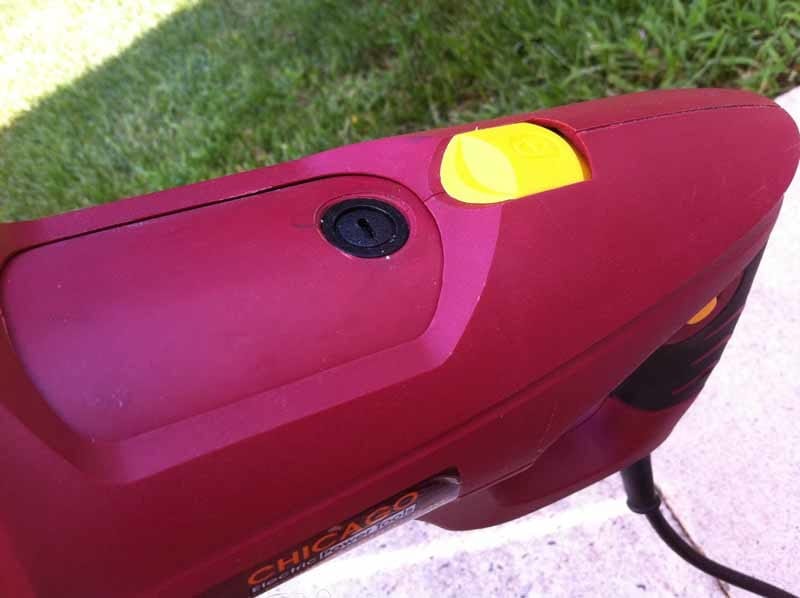
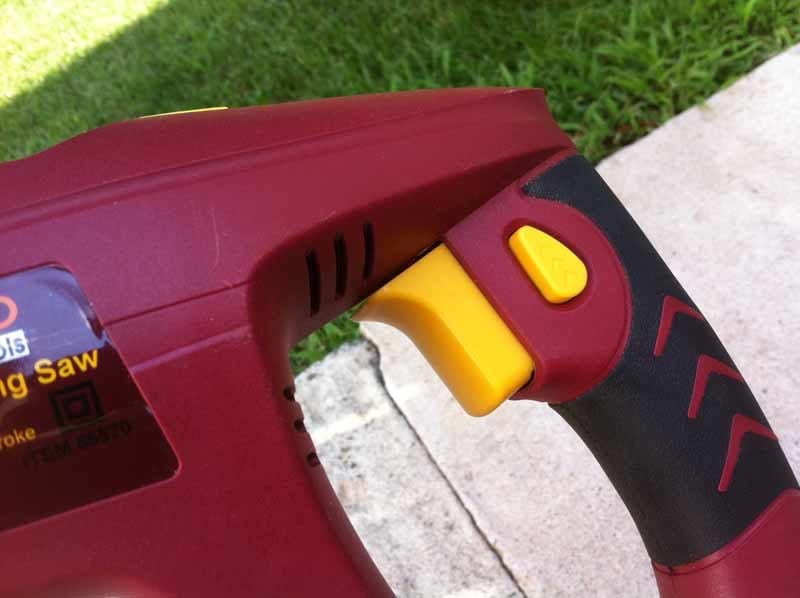
Rotating the tool’s 5-position grip is a simple process of pulling back the top locking lever with your thumb and twisting the body while maintaining a firm grip on the handle. The lever wasn’t so hot at springing back into place, however, so expect to have to give it a little push to re-seat it when you get to your desired cutting angle. The action varied, with it auto-locking about 4 out of 5 times. This button, the trigger, and the trigger lock also looked and felt cheap, but not so much as to think they would not last under continuous use. Be sure to keep the mechanism clean and free from debris.
Using the Chicago Electric Rotating Handle Reciprocating Saw
Inserting the blade is done by twisting the blade holder and pushing it in until it’s fully seated. The shoe is set back pretty far and doesn’t really adjust, so you may find yourself cutting on the same section of blade and wearing them out faster. This isn’t uncommon with smaller entry-level reciprocating saws.
The trigger is easy to pull and has a variable speed. You can also use the side-mounted trigger lock for extended use without having to keep the trigger down. For us, it worked well, but the trigger and the lock seemed to be of really cheap quality, and we’re not sure how much abuse it can take in terms of prolonged use and environmental contaminants.
The Chicago Electric rotating handle reciprocating saw cuts nicely, and the shoe kept a comfortable angle on dimensional lumber as we made our cuts. While the tool doesn’t come with an orbital mode, it was easy to rock the tool back and forth to get through cuts quickly. The 30-degree maximum angle of the shoe made it especially easy to do this and keep positive contact with the workpiece. We found the rotation mechanism a bit unpredictable, but never difficult to use. Even when the mechanism didn’t automatically lock, it was easy to push the release button back into position and proceed with our cut.
Conclusion
This is a tool that is easy to recommend. While we don’t exactly feel that it will be an enduring product, the $20 price tag (look for sales or a coupon) makes it hard not to get excited about. The tool cuts easily (and will cut even better if you pop a better blade into it) and the ergonomics can’t be beat. Are there better reciprocating saws? Yes. Are there better saws for the price? We don’t know if there is anything for this price. We’ve seen blades that cost more.
In any case, it was easy to give a Value rating that neared perfection, a 9/10. There is a lot to be desired on performance, and it’s certainly not intended for professional use – not by any stretch. Still, our 4/10 rating is no slouch. If you need a quick saw, this is going to be a hard deal to pass up. We’ll just call it a starter tool – and we’re sure many consumers will use it as a stepping stone to bigger and better saws.