
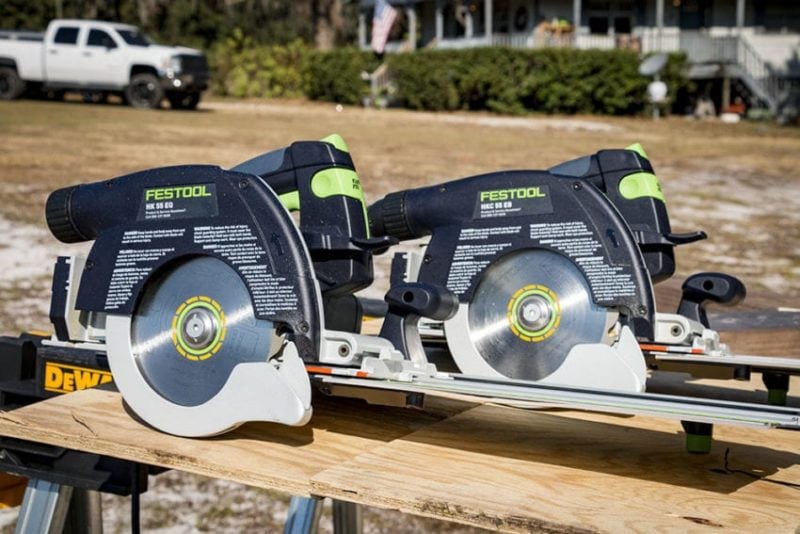
Back in 1922, Raymond DeWalt developed the radial arm saw as a powered circular saw that could slide for cutting larger stock. It wasn’t until the 1970s that we got the rotating table and the miter saw as we know it really began to take shape. When I first saw the Festool HK 55 Carpentry Saw, I was pretty impressed. My mind immediately started running in all kinds of directions when I considered the possibilities.
More than just a track saw, the HK 55 and HKC 55 challenges the miter saw’s dominance on the jobsite.
Tracing its roots back to a circular saw that can slide and cut accurate angles, could there really be a replacement for the miter saw in a handheld unit?
That’s exactly what we aim to find out as we take a closer look at the Festool HK 55 Carpentry Saw and it’s cordless version, the Festool HKC 55. There’s a lot of versatility built around the design, so let’s jump right in.
Festool HK 55 Carpentry Saw and HKC 55 Carpentry Saw Key Features
The corded model features a variable speed dial. Though it is marked for speeds 1 – 6, they don’t lock into place so you essentially have infinite setting as you go.
Dust collection is built-in with a collection bag, though you’ll get better performance using a Festool dust collector.
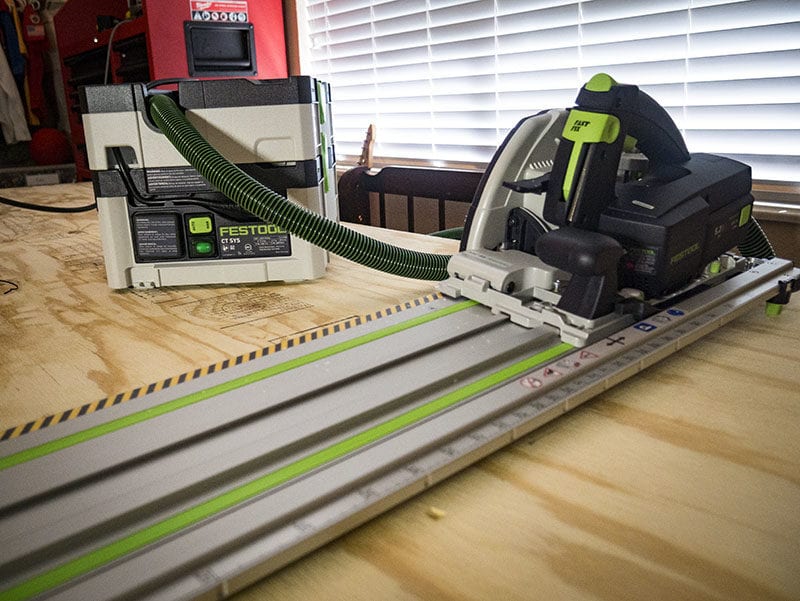
One feature that sticks out is the integrated riving knife in the blade guard. Whether used with a track or not, this will help guide the saw and prevent kickback.
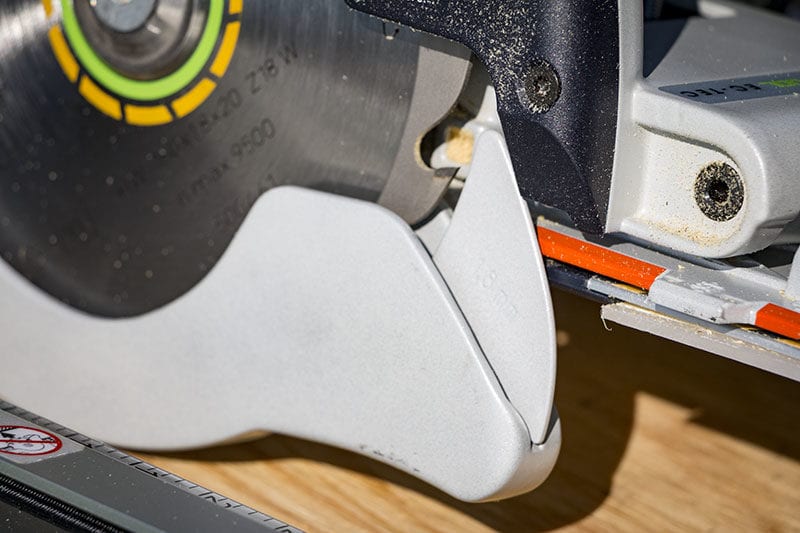
Plunge cutting is also a breeze thanks to a spring-loaded design. Simply hit the release lever and the spring brings the blade up. Wherever you set the depth of cut, the saw will lock back into place when you reach it.

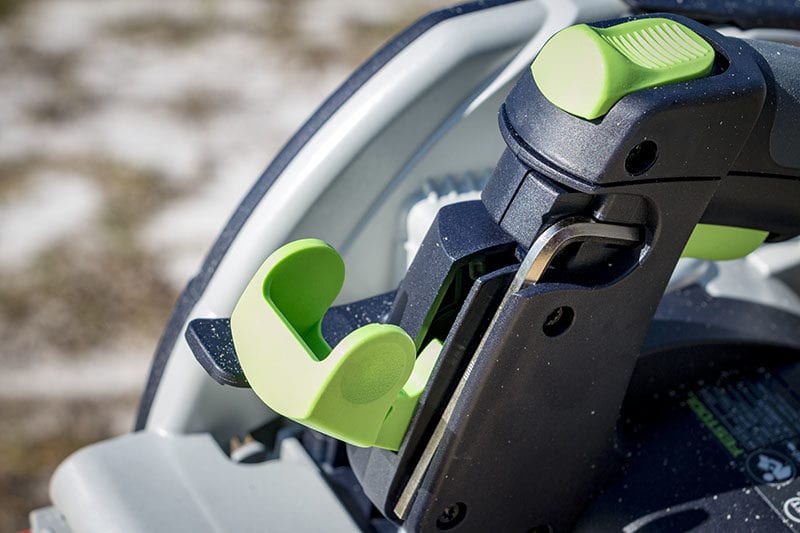
The hex wrench for blade changes is hidden behind a green Fast Fix mechanisim up front. With the mechanism open to allow access to the wrench, it locks out the saw so you can’t accidentally start it up.
Other Features Worth Noting
- Combines the functions of circular saw, track saw, and miter saw
- Spring-loaded guide rail makes fast and accurate cuts on the fly
- Handles rip cuts, cross cuts, and compound miter cuts in materials up to 55 mm (2.16″) thick
- Not compatible with any of the TS 55 blades or accessories other than rails
What It’s Designed to Do
Circular Saw
At its very core, the Festool TS 55 Carpentry Saw is a circular saw. Running at 1200 W, it spins the 6-1/4 inch blade up to 5200 RPM. The cordless model runs a little slower as far as that no-load speed goes, producing 4500 RPM.
Track Saw
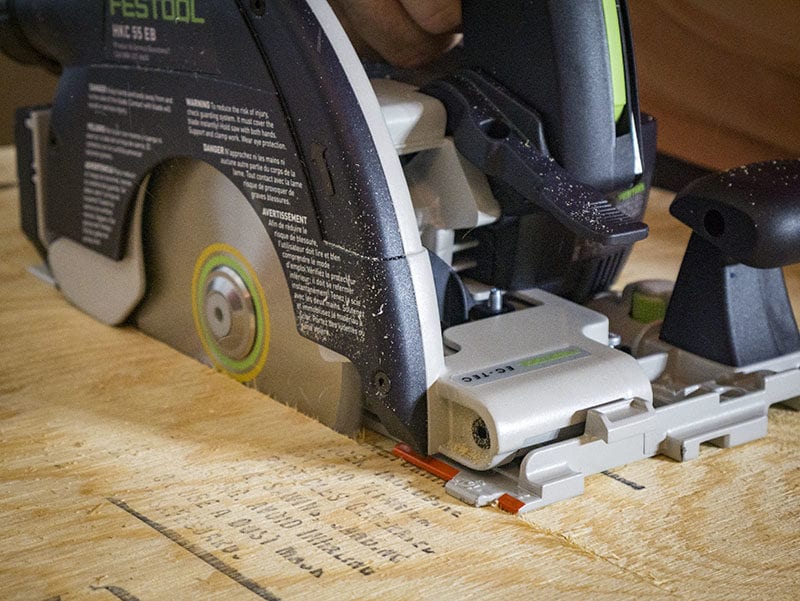
Like the TS 55 and TSC 55, the Festool HK 55 Carpentry Saw works just fine as a track saw and fits on the same Festool track as their other track saws.
Miter Saw
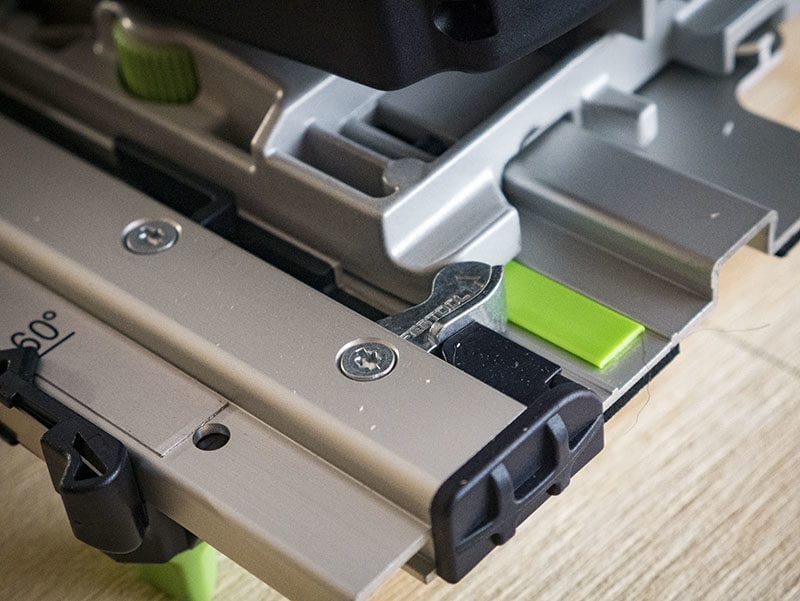
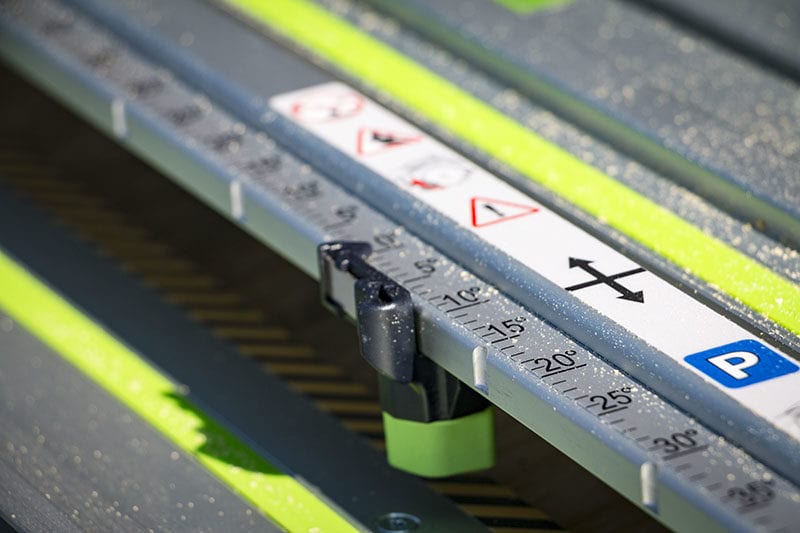
Both the HK 55 and HKC 55 Carpentry Saws were launched along with the new Festool FSK tracks. Most of the hype around the saws is focused on two specific innovations on the track. First, you have two contact points on the base of the track – one is fixed, the other movable. The movable contact point slides up and down the rail and can be screwed down to specific angles or lock into predefined detents just like a miter saw.
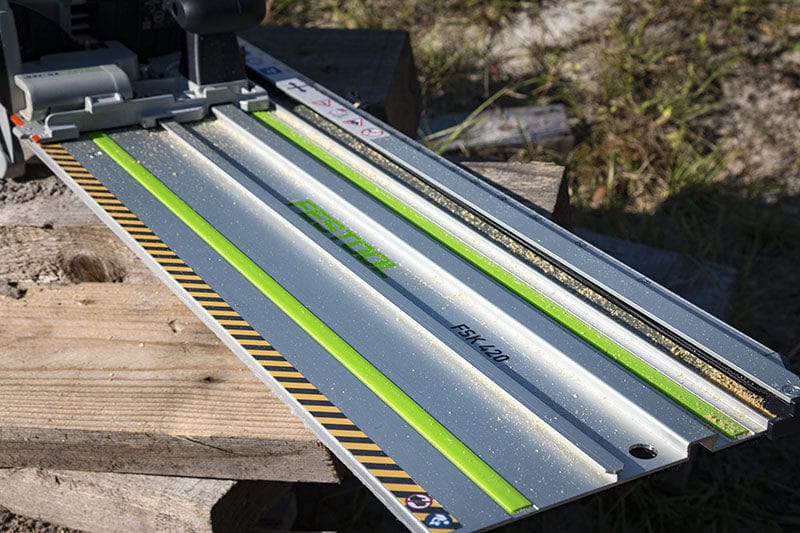
To make a cut, set the track on top of your material and slide it forward until both contact points are pressed against the edge. Simply slide the unit as a whole until the edge of the rail reaches your mark to start your cut and you’re good to go. The precision of Festool’s FSK track ensures that you can cut with your circular saw just as accurately as you could with your miter saw. Since the saw can bevel, you get compound miter functions out of your circular saw.
The FSK track also features an auto return function. When you reach the end of your cut on the rail, the track will return to its starting point leaving you ready to make your next cut without having to take your hand off the material or the saw.
Performance
If you’re new to Festool, try not to be too intimidated. Like it’s German reputation suggests, there’s a lot of precision and engineering built into the Festool HK 55 Carpentry Saw and its cordless counterpart. It may sound complicated at first, but once you use it a couple times, it’s actually very easy.
FSK Rails
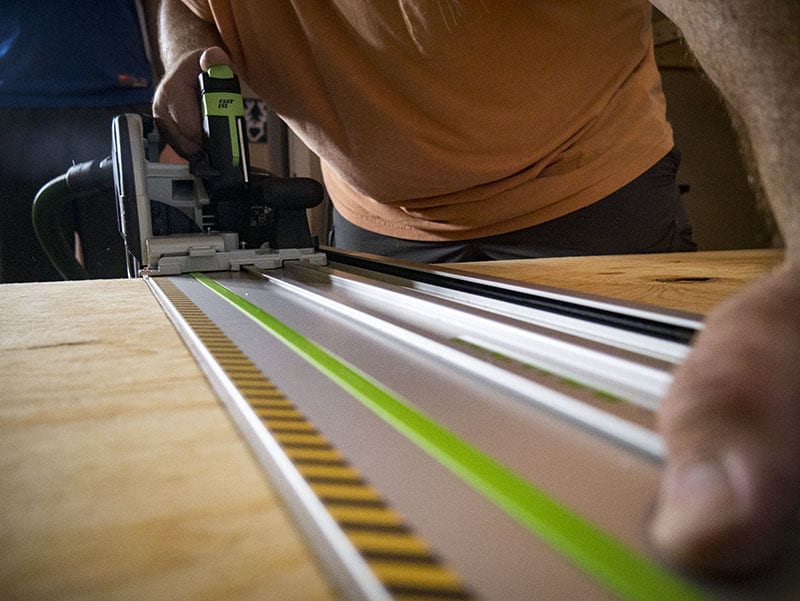
The FSK rails are remarkably easy to use. Simply slide the saw into the track and it automatically locks in place. Pushing the saw forward slightly and pushing the release forward will allow the saw to come back and slide off.
Two black strips on the bottom of the rails provide traction on material. This is great when you’re ready to make the cut, but can be tough to get a feel for at first when setting up the cut. On a couple of occasions, I noticed my contact points weren’t pressed against the wood the way they should be and had to reset. After a few cuts at several angles, getting a feel for the right placement became easier.
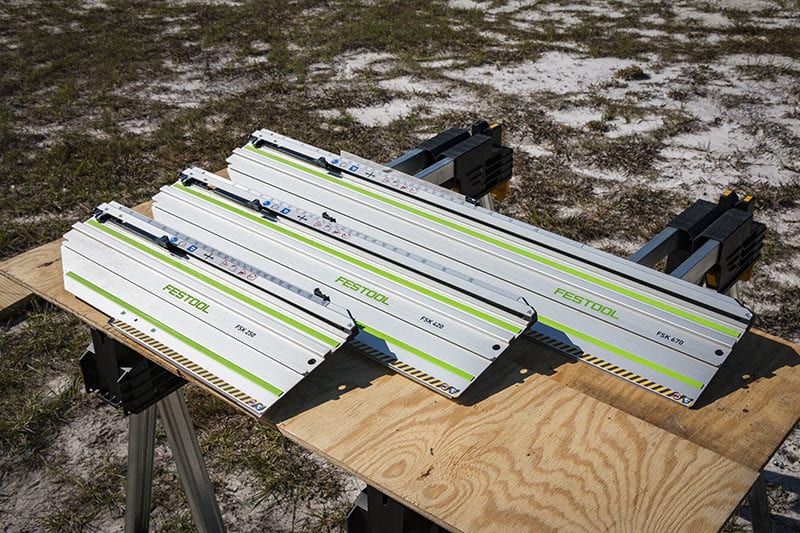
The FSK guide rails come in 10 inch (250 mm), 16-1/2 inch (420 mm), and 26 (670 mm) inch sizes. For most cross cuts, the 10 inch size is fantastic and of course, the least awkward and lightest weight to use. With a right hand 45-degree miter, the FSK 420 is just long enough to complete the cut in 2 x 12. Be sure to consider what length cuts you’re likely to come across when selecting a rail – or just buy all 3!
Miter Detents
Sliding the movable contact point into common miter detents is a matter of loosening the nut and selecting your angle. The pre-set detents lock in confidently, though the mechanism doesn’t slide as smoothly as a miter saw table. It will take a little getting used to along with some back and forth as you learn to move over the detents.
Accuracy
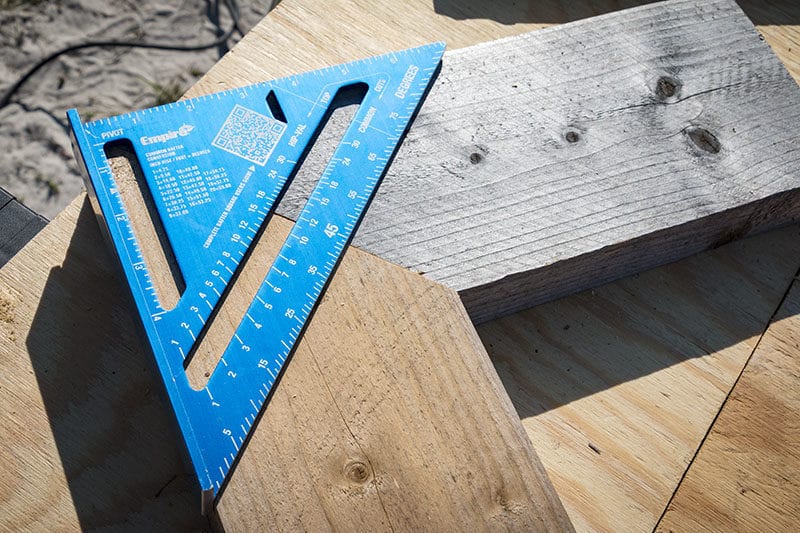
After making a few cuts, I was convinced it is just as accurate as any miter saw I’ve used. I cut a couple of 45’s and laid my Empire Level Laser Etched Rafter Square on the cut pieces. It was incredibly accurate – more than what would be necessary for framing. It will take more testing to see if it has the kind of accuracy required for fine woodworking.
Power
One of the big questions I had when I started was whether or not I would be able to feel a difference in the cutting experience between the corded and cordless models. After all, with very different no-load speeds, there’s clearly a difference between the two motors.
Both saws came with 18-tooth blades and you can indeed feel a difference. The Festool HK 55 Carpentry Saw feels like it has a stronger motor. The Festool HKC 55 Carpentry Saw seemed easier to bog down. On cross cuts in 2 x 12 PT, both saws cut extremely well. When I switched to a 45 in the same material, the cordless clearly had to work harder.
Limitations
My focus with the Festool HK 55 Carpentry Saw has been mainly on its use as a miter saw replacement. There are some clear limitations here, mainly from the fact that you’re working with 6-1/4 inch blade. You are definitely going to be able to make a deeper cut with 10 inch and 12 inch miter saws.
You’re also limited to just single bevel for compound cuts. That’s really not too big of a deal, but if you’ve been taught using a dual bevel saw and are really used to having the convenience of being able to go to both the left and the right with your angles, you’ll notice the difference.
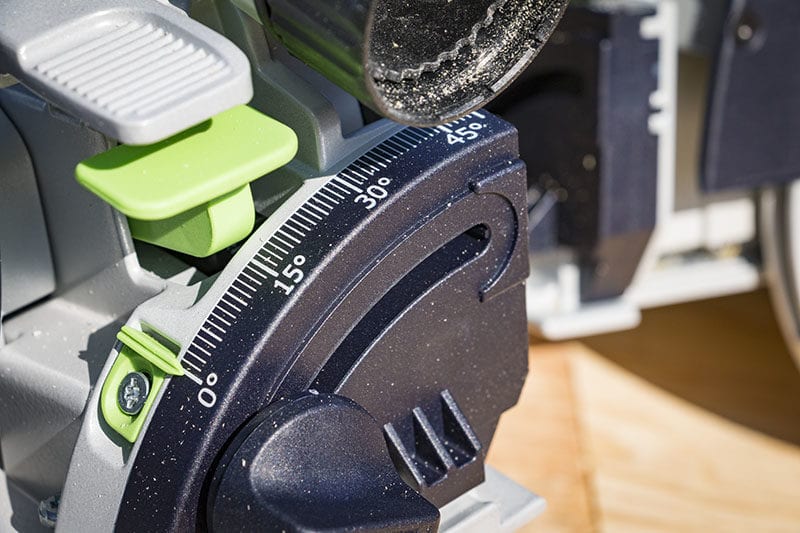
The longer two rails are capable of getting you miter angles to 60° both left and right. However, the smaller size will get you 45° to the left and 60° to the right.
And yes, there is a weight penalty that comes from using the rails. Just keep in mind that the system is designed to be used on top of your material – not overhead or vertically – and the weight starts to become a non-issue when considering you’re not setting up a miter saw and hauling your materials back and forth to it.
The Bottom Line
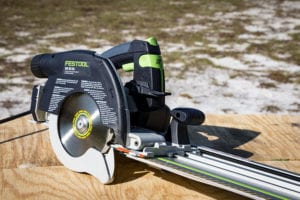
At the end of the day, the Festool HK 55 Carpentry Saw is able to handle most of the work I do with 2x material and sheet goods given the versatility to be used as a circular saw and with multiple tracks. For both models, the major advantage is the ability to bring an accurate mitering and beveling saw to your material instead of having to bring your material to your saw. This is a huge timesaver particularly if you’re working on rooftops or multiple stories when there’s no elevator or lift available.
I was initially concerned that the length and additional weight of having a rail attached to my circular saw would be awkward and cumbersome, but it really took very little time to get used to. There’s no doubt the advantages outweigh the those trade-offs. As long as you understand the limitations of what these saws can do, especially when it comes to depth of cut, I think it will be awfully hard to be disappointed in their performance and I can easily recommend it to any Pro who will benefit from increased efficiency on miter cuts.
The question that remains is whether to go with the corded Festool HK 55 Carpentry Saw or the cordless HKC 55 Carpentry Saw. I personally prefer the muscle of the corded model. At the same time, cordless convenience is awfully hard to ignore. I really don’t think you can go wrong with either choice – or you can just do what I did and get one of each.
Festool HK 55 Carpentry Saw Specifications
- Model: Festool HK 55 EQ-FSK420
- Power Consumption: 1200 W
- No-load Speed: 2,000 – 5,200 RPM
- Saw Blade Diameter: 6-1/4″ (160 mm)
- Angle range: 0-50°
- Max Cutting depth: 2-1/8″ (0-55 mm)
- Cutting depth: 1-5/8″ @ 45 degrees, 1-1/2″ @ 50 degrees
- Blade Location: Right
- Dust Port: 27/36 mm
- Weight: 9.7 lbs (4.4 kg)
- Includes: 18 tooth saw blade, SYS 4 SYSTAINER, FSK 420 Guide Rail
- Warranty:3 years limited
- Price: $590
Festool HKC 55 Carpentry Saw Specifications
- Model: Festool HKC 55 EB
- Motor: Brushless
- Electric motor brake: Yes
- Battery capacity: 5.2 Ah
- Battery Voltage: 18V
- No-load Speed: 4,500 RPM
- Saw Blade Diameter: 6-1/4″ (160 mm)
- Cutting depth 0°: 0 – 2-1/8″ (0-55 mm)
- Cutting depth 45°/50°: 1-5/8″ / 1-1/2″ (42/38 mm)
- Blade Location: Right
- Dust Port: 27/36 mm
- Weight (incl. saw blade): 9.25 lbs (4.2 kg)
- Includes: 18 tooth saw blade, (2) 18-V Li-Ion, charger, SYS 4 Systainer, FSK420 Guide Rail
- Warranty: 3 years limited
- Price: $399