
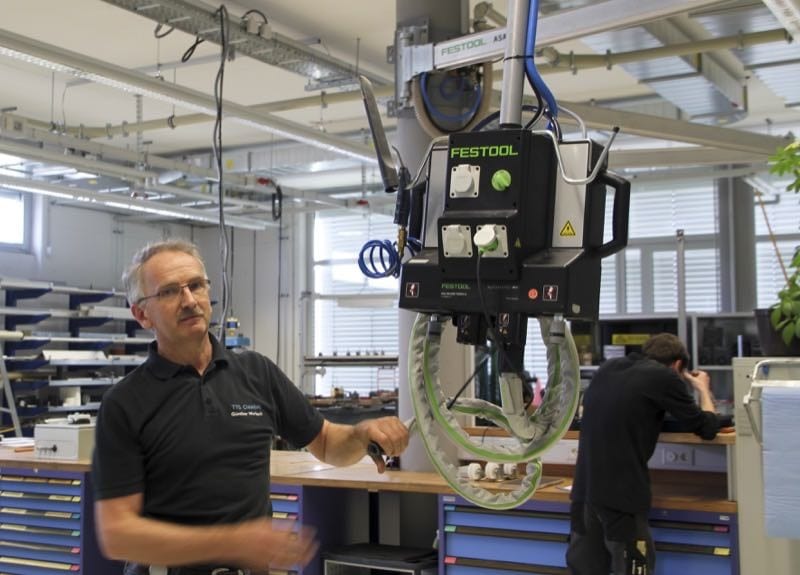
One of the things I really enjoyed during our recent Festool media event in Germany was touring several facilities where they test, certify, and otherwise push their own tools to the limit. I brought along PTR vice president Tina DeBoer, who happens to have a degree in physics. Her first response was that, had she known tool companies tested products like this, she would have applied for a job there 20 years ago! Needless to say, it’s a lot of fun for people who enjoy working with high-tech equipment and conducting experiments. We learned that Festool tool testing is extensive and leaves very little to chance.
TTS Tooltechnic Systems Test & Qualification Lab
In the TTS Tooltechnic Systems test & qualification lab, they qualify and prototype Festool machines in their own facilities. They work closely with European test authorities to ensure the accuracy of their results and have six employees, including three trained apprentices, who specialize in microelectronics. Needless to say, they utilize a great deal of computers and test equipment. Among the machines in the lab, we saw a CNC mill and, of course, their own Festool Turbo Extraction Turbine system (TURBO II M-14WP), a regulated M-class dust extraction system that can handle up to 14 different workstations simultaneously.
Aside from multiple design rooms, there was a room with a Festool tool testing station to analyze their CT Series dust extractor motors, both inside and outside the machine. They measure temperature, run time, and more to ensure the motors function properly and will withstand the test of time and environmental conditions associated with the various venues in which they’re likely to be used.
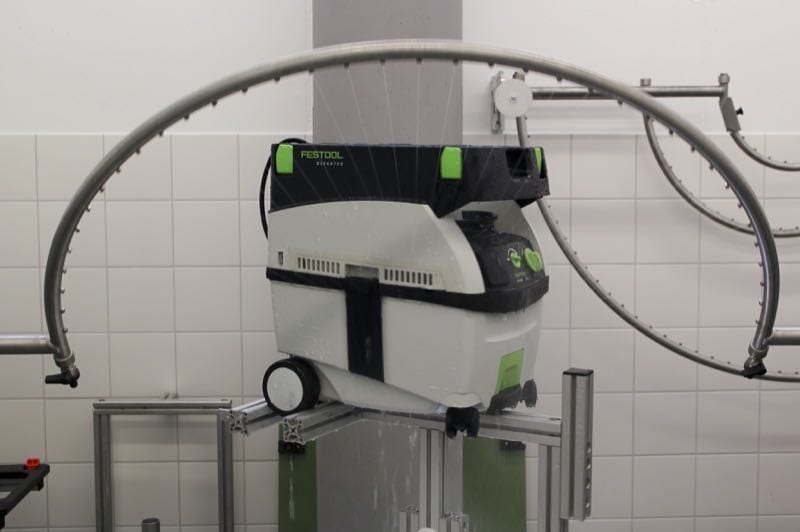
In another room, TTS measures and tests how the extractors work with steady jets of water hitting it from all angles and at various pressures. This was an impressive room with an open grate floor that allowed water to be collected and recycled below. There’s also a high-voltage test to make sure electrical safety designs are sufficient. We opted to let them perform the electrical testing when we weren’t standing in the room.
One interesting testing area was designed to utilize a high-speed camera to capture how the cleaning function works, allowing Festool and Tool Technic Systems to visually verify that a device like a CT dust extractor is operating properly. I imagine they would capture video similar to what you’d see here:
The next room beat the living plastic out of a Festool CT 36 dust extractor, simulating the extractor being dragged over endless 1×2 “speed bumps,” which should have ripped the wheels off, but instead seemed to verify the fact that these dust extractors can really take a beating. The idea is to simulate a door threshold, but the dust extractor (which could be filled with anywhere from 35-55 lbs of material) gets dragged over a distance of 40 miles at a speed of 3 mph (Quick math quiz: How long does this test take? Answer is at the bottom of the review).
In other areas, tools are tested for drops and placed in environments where dust and sand are blasted at them to assess their performance under adverse working conditions. There’s even a room where TTS could simulate various atmospheric conditions. By placing the dust extractor or even a Festool ETS EC 150 orbital sander into a large, atmosphere-controlled box, they can run the tools at high temperatures and with high humidity. Here’s a video of a Festool Carvex jigsaw, which was drop tested and sandblasted:
Not only are the exterior parts checked, but the internals must pass as well. Lot’s of testing is done to ensure that each and every component of a tool—in this case the Festool CT dust extractors—perform to expectations.
Having a degree in recording engineering, it’s always fun to see how companies perform loudness tests, and Festool didn’t disappoint. A room with a quasi 3-pi environment allowed for very accurate measurement of the SPL output of various tools. Festool can then take measurements from all different directions using ceiling-mounted microphones that can be adjusted to various positions and heights to match the tool. This allows them to make adjustments during the prototype testing phases as needed. Like any good studio, the results are measured from an adjacent workstation outside the room so that nothing interferes with the recording process.
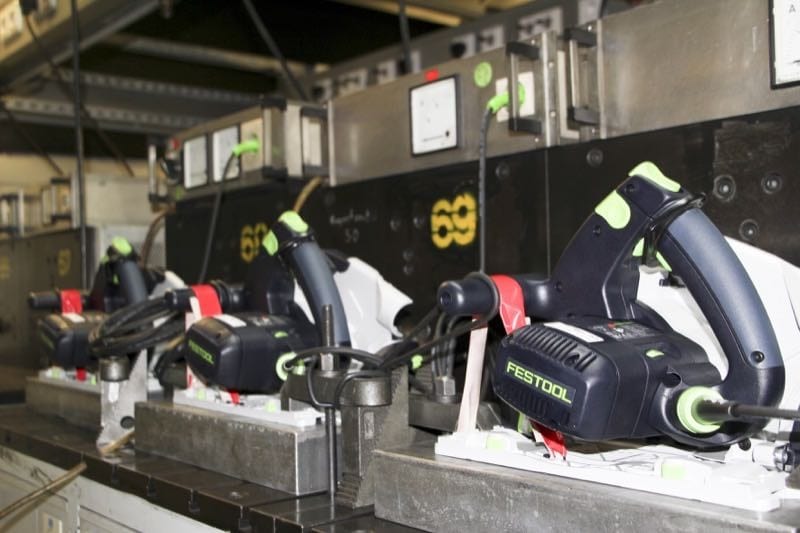
A continuous operation room operates the dust extractors and/or power cycles them repeatedly to check and verify life expectancy for the motors and related components (switches, etc). They are simulating the lifetime of a dust extractor and the conditions it needs to face—including a full 24-hour stress test. Festool CT Series dust extractors are designed and expected to last for 800 hours, followed by an additional 400 hours of use after replacing the brushes. Those were the specifications we saw being tested in the room (in addition to others).
Our last stop was to a lab where a 3D measuring device can be used to detect any part abnormalities that might not be visible to the naked eye. This allows TTS and Festool to compare the results to the factory measurement specifications. In the same area, they could also determine the optimal torque for fastening into the various plastic components—very important for correctly setting their tools within the Festool Neidlingen factory. This helps them establish the highest speed and torque assembly possible without incurring any damage to parts in the process.
Conclusion
Extensive testing and verification is essential to knowing that your tools not only work out the door—but that they will hold up under active use out in the field. It was great to see Festool not only working to test new products (which we can’t share with you now under risk of dismemberment), but to also witness them continue to verify and test their existing product line to see if anything could be improved. It became very clear that, while TTS does a bang-up job to ensure quality on the front end, the company also makes certain that any potential tool failures or issues are followed up with adequate testing to make improvements or recommendations on the fly.
Quiz answer: About 13 hours and 20 minutes!