
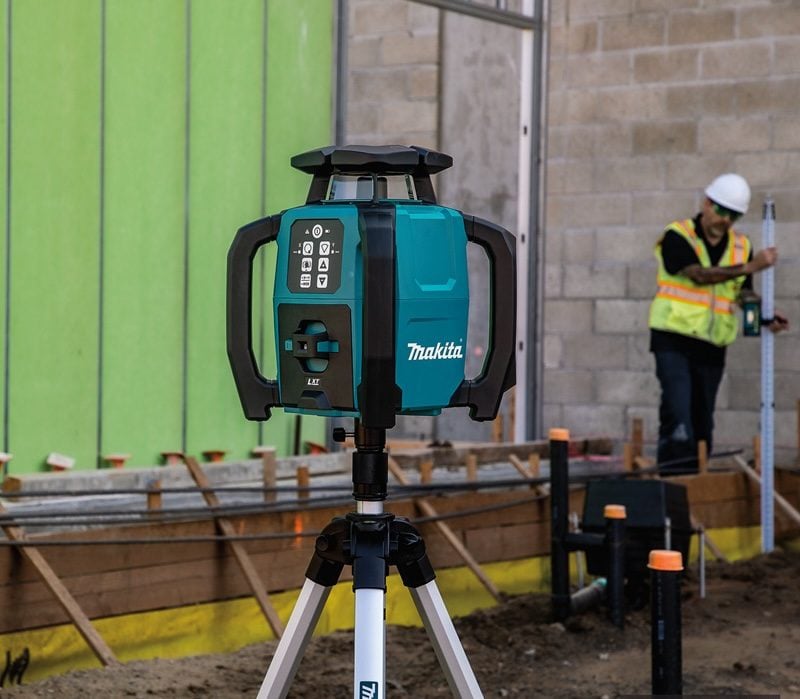
Makita’s First Rotary Laser Debuts With Impressive Specs
While Makita’s XGT and LXT systems include many common professional-grade jobsite tools, a rotary laser has been one tool type missing thus far. At least, until now. The Makita 18V LXT Dual-Slope Green Rotary Laser boasts some impressive stats right off the bat, but is it worth adding to your jobsite? I’ll walk you through what we know about this tool and compare it to similar models from other brands.
Read
Rotary vs Cross-Line Lasers for Interior Installations
Makita 18V LXT Rotary Laser: Overview
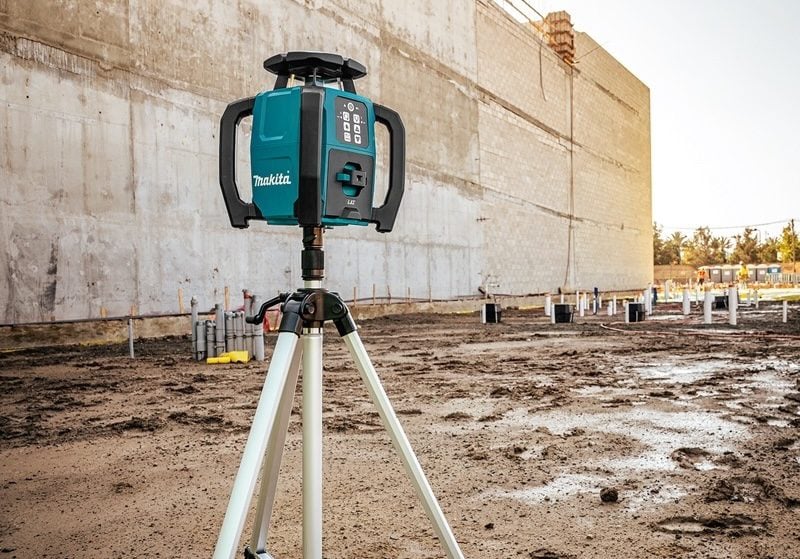
- Model: Makita SKR001
- Power Source: 18V LXT battery (or 40V XGT battery w/ adapter)
- Accuracy: ± 1/16-inch (horizontal); ± 1/8-inch (vertical) at 100 ft
- Self-Leveling
- Laser Rotation Speed: 150 / 300/ 600 RPM
- Runtime: 135 hours (18V battery); 160 hours (40V battery)
- Operating Range: 2600 ft
- Control Range: 100 ft
- Ingress Rating: IP67
- Vertical Plumb Beam Range: 98 ft
- Laser Type: Class 2, green
- Weight: 8.8 lbs (bare)
- Drop Protection: 6 ft
The SKR001 is Makita’s first rotary laser to date on the 18V LXT platform. It has a maximum operating range of 2600 feet, with an accuracy level of ±1/16-inch (horizontal) and ± 1/8-inch (vertical) at 100 feet. As a 360° laser, it also has a 98-foot vertical plumb beam range, letting you read your measurements at any direction.
While this model is advertised as an 18V tool, you can also power it with an XGT battery, by way of a 40V adapter (LE00981913, sold separately). This is handy for jobsites that already use 40V Makita tools, eliminating the need to buy into another platform.
This rotary laser features three rotation speeds: 150 RPM, 300 RPM, and 600 RPM. The 600 RPM setting enables the 2600-foot max range, and the 150 RPM and 300 RPM speed modes are ideal for interior and short-distance laser measurements.
Using an 18V LXT 6.0Ah battery, this laser can run for up to 135 hours at the highest speed setting. If you opt to use a 40V battery, you can power it for up to 160 hours with a 4.0Ah pack. For concrete leveling, surveying, or other indoor/outdoor construction jobs, that’s plenty of runtime to keep you powered up all day—or even all week—without needing a battery recharge.
On the design side, this Makita laser features four-sided rubber handles, designed to absorb impact from falls and tripod tip-overs up to six feet. It even includes a tip-over alarm to alert you if it detects a fall. An IP67 ingress rating further protects the tool against water and dust on the job.
Additionally, the SKR001 is compatible with tripods with 5/8-inch threaded screw mounts, and you can place it either vertically or horizontally.
How Does It Compare?
There are several brands that offer comparable models to Makita’s version, with differences in figures like operating range and price. Here’s a side-by-side look at similarly-classed models from Milwaukee, Bosch, and Hilti.
| Makita SKR001 (This model) | Milwaukee 3704-21 | Bosch GRL4000-80CHV | Hilti PR 400-22 | |
|---|---|---|---|---|
| Max Operating Range: | 2600 ft | 2000 ft | 4000 ft | 2600 ft |
| Power Source: | 18V LXT battery | M18 battery | Core 18V battery | 22V battery |
| Slope: | Dual Slope | Dual Slope | Horizontal Only | Dual Slope |
| Laser Speed Range: | 150 – 600 RPM | 600 RPM | 150 – 600 RPM | 300 – 1000 RPM |
| Price: | $2,419 bare | $2,399 kit | $2,699 kit | $2,781 bare |
Makita 18V Rotary Laser Price
This rotary laser retails for $2,419 for the bare tool. It includes a wall mount bracket, a remote control, a laser receiver bracket, an LXT battery tray, laser safety glasses, a target plate, and a hard carrying case. There are no kit options available at this time, so be sure to pick up a Makita 18V LXT battery and charger if you’re not already on this platform.
If you’d like to use this laser with a 40V battery, Makita also sells an XGT battery tray (LE00981913) adapter that’s compatible with those batteries.
Should You Buy It?
There’s no question that this is a professional-grade tool, and the price tag reflects that. However, it’s not out of the realm of what we normally expect price-wise for this class of laser, especially with its generous 2600-foot operating range.
It goes without saying that this is not the best choice for basic DIY interior remodels or short-range laser measurements. There are far less expensive tools, like cross-line models, from many tool brands that are purpose-built for those applications.
This tool is best for Pros already on Makita’s 18V or 40V (with the adapter tray) platforms. One of the biggest advantages of these systems is their compatibility across the entire lineup, so taking advantage of that with your jobsite’s rotary laser makes the most sense.