
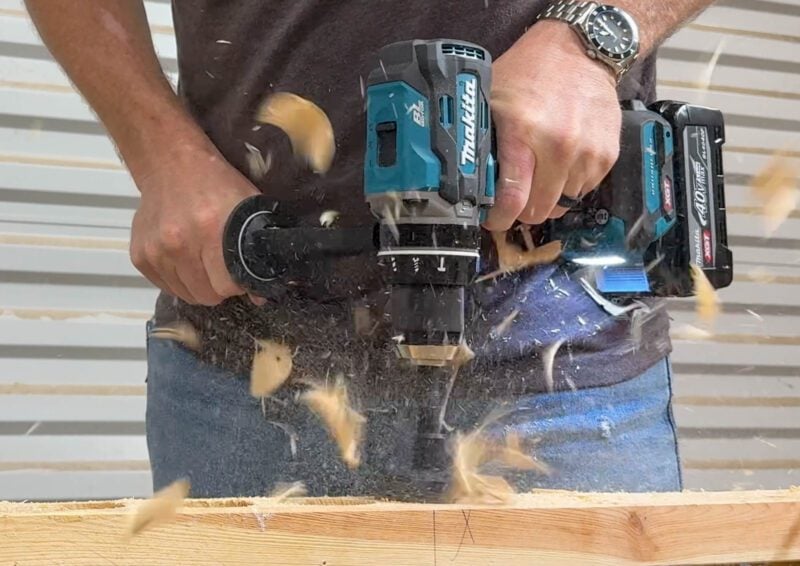
We just wrapped up testing the latest hammer drill in the Makita 40V max XGT lineup—the GPH03. This monster drill boasts some pretty impressive specs that truly got our attention from the get-go. I’ll show you what it has to offer and what I discovered after testing it head-to-head against its predecessor. Should you upgrade? Let’s find out!
Pros
- Top tier torque
- Excellent driving power
- Sound ergonomics
- Three speed settings
- Electronic clutch system
- Anti-kickback protection
Cons
- Expensive
- Bulkier than other XGT drills
Makita 40V max 3-Speed Hammer Drill Performance
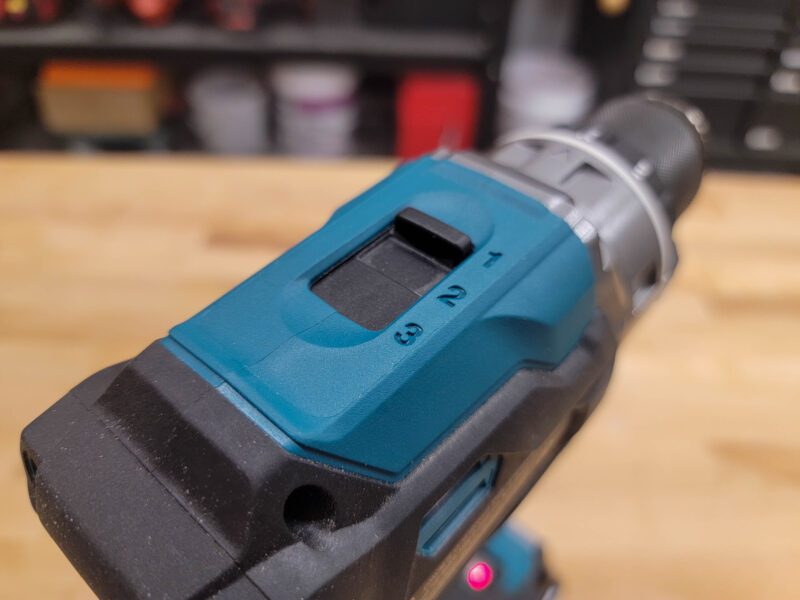
- No-Load Speed: 0-650 / 1,800 / 2,400 RPM
- Hammer Rate: 9,750 / 27,000 / 36,000 BPM
- Max Torque: 1,590 in-lbs
Speed and Power
At its heart, the Makita GPH03 is powered by a brushless motor that produces a top speed of 2,400 RPM and a max hammer rate of 36,000 BPM. As for muscle, this drill sports 1,590 in-lbs of torque—far outpacing its predecessor, the GPH01, which sits at 1,250 in-lbs.
What’s interesting is that the GPH01 is actually faster and has a higher BPM rating than the GPH03. With that in mind, we wanted to know how these two models compared head-to-head when put through our standard battery of tests. These tests are timed and averaged, and include an array of common drilling and driving tasks that you’re likely to encounter on a jobsite.
You can see the full details of how we run these tests in our Best Cordless Drill feature.
- Driving Structural Screws: Average time to drive 3/8-inch x 8-inch GRK RSS screws into stacked and glued OSB
- Light Rough-in: Average time to advance a 1-inch spade bit through 4 inches of stacked/glued OSB
- Heavy Rough-in: Average time to run a 2 9/16-inch self-feed bit thtough a single pine 2×4 stud
- Concrete Drilling: Average time to drill a 3/8-inch concrete bit 3 inches deep in 4000 PSI concrete
- Torque Challenge: The remaining height (if any) once the motor stops after driving a 10 x 1/2-inch lag bolt into stacked/glued OSB
Here’s how it all panned out:
| GPH01 | GPH03 | |
|---|---|---|
| 8-Inch GRK RSS Screw | 2.03 seconds | 2.43 seconds |
| 1-Inch Spade Bit | 2.62 seconds | 2.69 seconds |
| 2 9/16-Inch Self-Feed Bit | 1.59 seconds | 1.86 seconds |
| Concrete Drilling | 7.56 seconds | 8.65 seconds |
| 10 x 1/2-Inch Lag Bolt | 3.25 in. remaining | 2 in. remaining |
As you can see, the older GPH01 held the lead in four out of five tests up until the lag bolt. As I mentioned earlier, the GPH03 is slower than its predecessor so these results didn’t really come as a surprise. But, when it came to brute strength, the GPH03 was able to drive the lag bolt deeper into our test block, which is an impressive feat.
This simply highlights that the inverse relationship between speed and torque. Granted, driving a bolt of this size is really a job for an impact wrench, but it’s a good visual representation of the drill’s driving power.
Makita 40V max 3-Speed Hammer Drill Design Notes
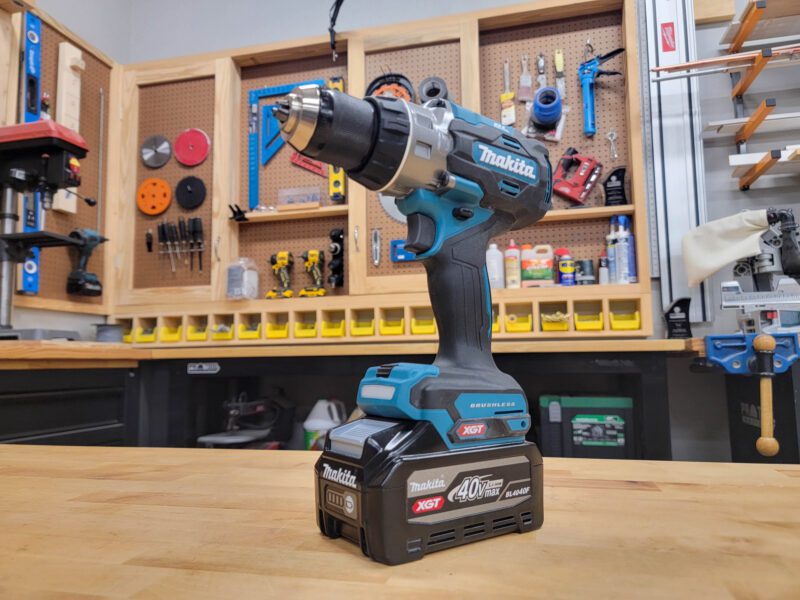
- Model: Makita GPH03
- Power Source: Makita 40V battery
- Weight: 4.1 lbs (bare tool), 6.1 lbs (with 4.0Ah battery)
- Head Length:
Size and Weight
The Makita GPH03 weighs in at 4.1 pounds as a bare tool, 6.1 pounds with the kitted 4.0Ah battery, and measures 7.75 inches from tip to tail. This is marginally heavier and longer than the GPH01 which has a working weight of 5.75 pounds and measures 7.13 inches long. But keep in mind, it is a three speed model that’s built for heavy-duty applications, so a little extra weight is to be expected.
Ergonomics
In spite of its weight, this drill is very well-balanced and easy to maneuver. The grip and motor housing are covered with a generous amount of rubber overmolding and there are several “bumpers” to protect the tool in case of a drop.
Looking down towards the foot, you have a large diffused LED work light as well as Makita’s digital clutch system (more on that later).
Kickback Control
The GPH03 features Active Feedback Technology, AKA kickback control. When activated, the motor automatically shuts down when it senses the bit bind, and the drill twists about 90°. It’s important to note that the AFT will only activate when the drill is in forward rotation, so exercise caution if there’s a potential of binding up when removing larger fasteners.
What’s unusual compared to some of the other kickback control systems we’ve used is that it’s not a hard stop. Instead, it’s more of a quick deceleration.
Regardless, it’s still an important safety feature and we’re glad that Makita is keeping it around.
Electronic Clutch
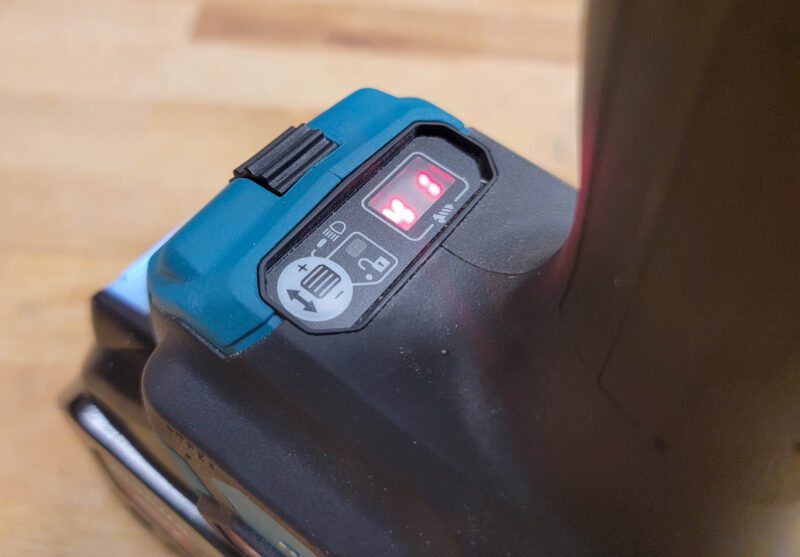
One of the most interesting features of this drill is Makita’s electronic clutch system. Rather than being near the chuck, Makita opted for a foot mounted design with a rotating dial to navigate the settings.
In total, you get 96 clutch settings—41 in low, 30 in mid, and 25 in high. This is a stark departure from most drills that only have around 20. These additional settings give you a high level of control and allow you to dial in the torque to match a wider range of fasteners.
The nice thing is that the chuck settings are stored in the internal memory even if you switch speeds. So if you’re going from high speed drilling a pilot hole down to low speed to drive your fastener, you won’t have to go back and reset your clutch setting.
Makita 40V max GPH03 VS GPH02 VS GPH01
Here’s a quick look at how the GPH03 compares to other models on the 40V max XGT platform.
| GPH03 | GPH02 | GPH01 | |
|---|---|---|---|
| No-Load Speed | 2,400 RPM | 2,200 RPM | 2,600 RPM |
| Max Torque | 1,590 in-lbs | 585 in-lbs | 1,250 in-lbs |
| Hammer Rate | 36,000 BPM | 33,000 BPM | 39,000 BPM |
| Bare Tool Weight | 4.1 lbs | 3.74 lbs | 3.68 lbs |
| Bare Tool Price | $259 | $209 | $259 |
Should You Buy It?
The GPH03 isn’t the fastest drill in Makita’s XGT line, but it leads the charge when it comes to torque. That power does come at a price, and the cost is some extra weight and length over the GPH01.
I personally don’t have an issue with the weight when I need a drill with maximum torque. However, if you’d prefer to find the best balance of size and performance, this probably isn’t a good fit.
So then, who is this drill for?
Well, after all of our testing, it’s clear that Makita is targeting folks who need maximum power and unparalleled precision. It’s a good fit for Pros who want one drill for everything, including tough rough-in applications.
With that said, if you’re truly happy with your GPH01, I don’t think there is a major advantage to purchasing the GPH03 unless you simply need more torque.
You can pick up the GPH03 for $259 as a bare tool or $399 as a kit. The kit includes a charger, 4.0Ah battery, and a carrying case. Makita backs this drill with a 3-year limited warranty.