
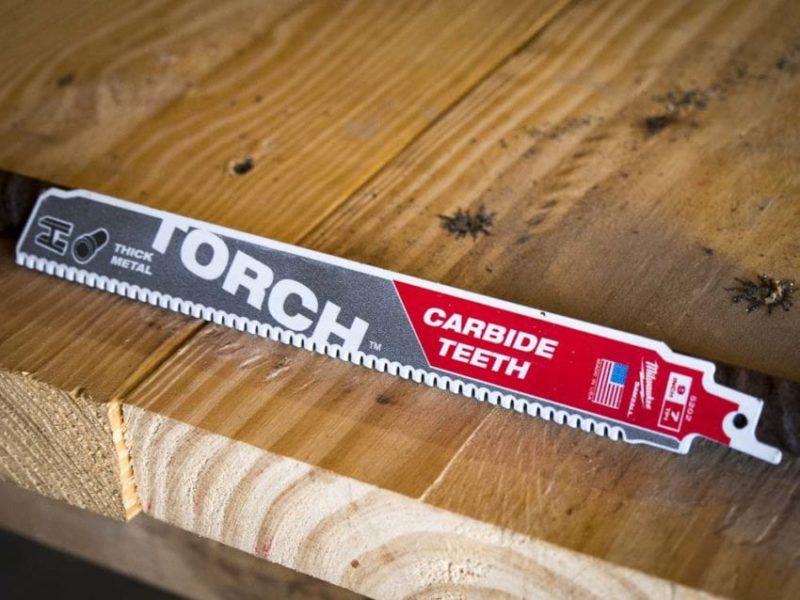
In 2018, the Milwaukee Sawzall blade lineup expanded with the introduction of the Milwaukee Torch with Carbide Teeth. Following the successful launch of the brand’s Ax with Carbide Teeth for wood cutting, the Torch now sports a new grill as well.
Of course, carbide is the buzzword around reciprocating saw blades these days. We’ve been taking advantage of carbide-tipped circular saw blades for much longer, but it’s taken longer to get a foothold with reciprocating saws.
So what’s the big advantage? Durability is the name of the game. It’s not unusual for a bi-metal blade to cut more quickly in wood and metal than carbide, but it’s very limited in life. Once you start moving into tougher material like the thick metals the Milwaukee Torch with Carbide Teeth is designed for, bi-metal can have trouble completing just one cut.
Performance Testing
There is a slew of materials we could test the new Carbide Torch with. We chose to go with 5/8″ rebar (#5). With a relatively small diameter but made of solid metal, it forces the teeth to work the entire cut. In larger pipes, the responsibility shifts from the top to the outside and back into the bottom of the cut.
We also assigned Milwaukee’s M18 Fuel Sawzall with One-Key to the job. With the ability to dial in the exact material you’re cutting and the blade you’re using, it dials in the soft start and cutting speed that’s optimal for the job.
One of Milwaukee’s claims is that the Carbide Torch can make up to 50 cuts in 1/2″ rebar. With the diameter a 1/8″ bigger, we made 42 cuts before the blade gave up its ability to cut effectively. That’s pretty solid.
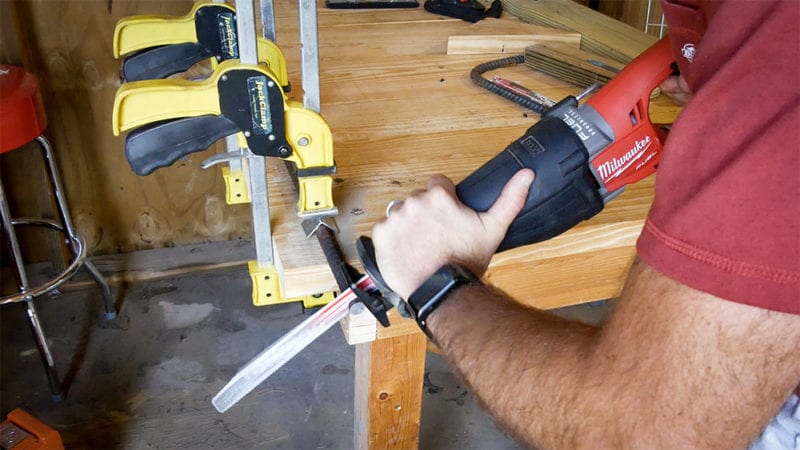
When it comes to speed, the blade starts quickly before settling in. Our fastest cut was 11.3 seconds. By the time it settled into a rhythm, we were looking at an average of around 17 seconds.
For thickness, Milwaukee is slightly thinner than Lenox’ and slightly thicker than Diablo’s respective carbide blades. Dialing in the thickness helps stabilize the cut and reduce chatter, but there are clearly multiple theories on what’s exactly right.
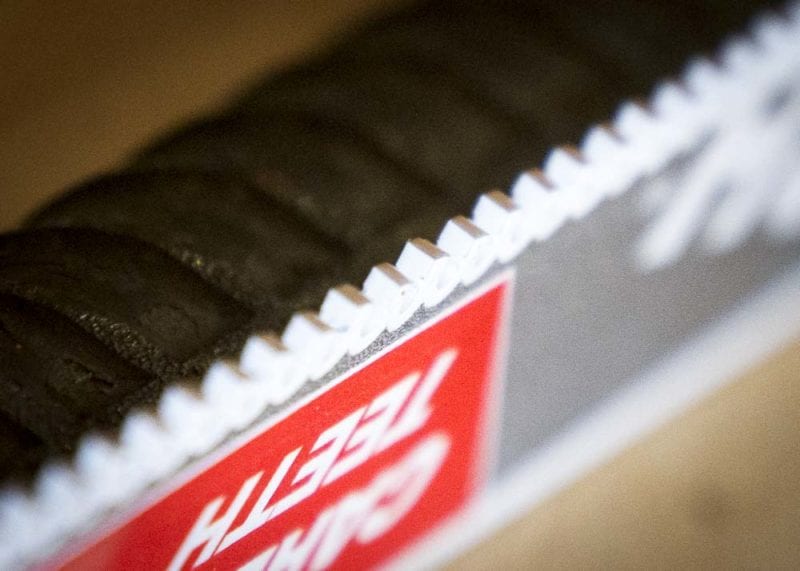
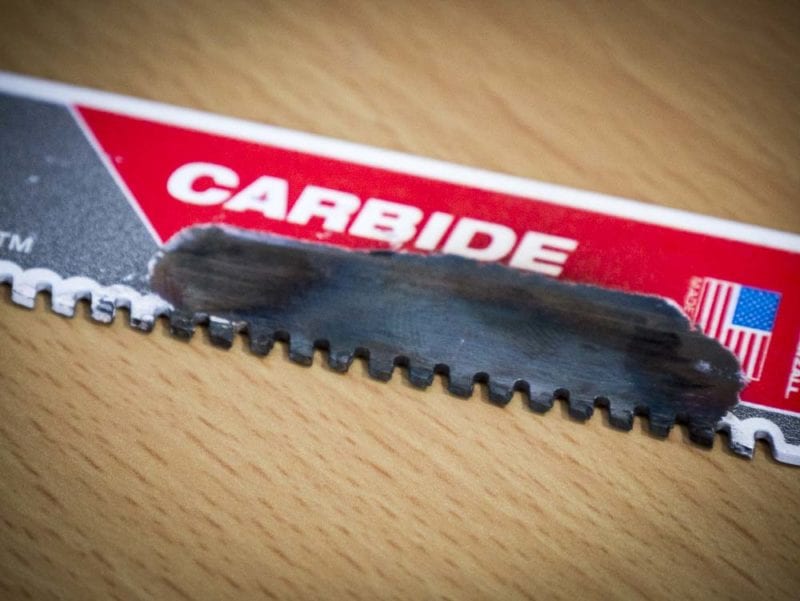
Starting at cut #8, sparks started showing up, and they were pretty frequent by cut #12. Still, the blade continued cutting well, despite an increase in vibration and chatter. The increase in chatter is something we expect as the blade starts to wear. At just 7 TPI, it’s a really low tooth count compared to bi-metal blades and even 1 less than the major carbide competitors. By the time we called it at cut #42, my arms were begging for a break.
The Bottom Line
Given our testing in rebar, the Milwaukee Torch with Carbide Teeth doesn’t cut like a first-generation carbide blade. It has a longer lifespan than we expect and a solid cutting speed. It’s not the best we’ve tested (sorry, no spoilers this time), but it is a solid all-rounder. With 7 TPI, you’ll notice more chatter as you get towards the end of its life. However, if you keep your blade speed down for thick metal, it will last a good long time.
Milwaukee Torch with Carbide Teeth Key Features
- 7 TPI tooth count
- Rated for thick metals, including cast iron, stainless steel, rebar, angle iron, black pipe, rigid conduit, boron, and more
- Made in the USA with Global Materials
Milwaukee Torch with Carbide Teeth Specifications
- Model: Milwaukee 48-00-5202 (9″ blade)
- TPI: 7
- Length: 6″, 9″ (tested). 12″
- Height: 1″
- Construction: Steel with carbide teeth