
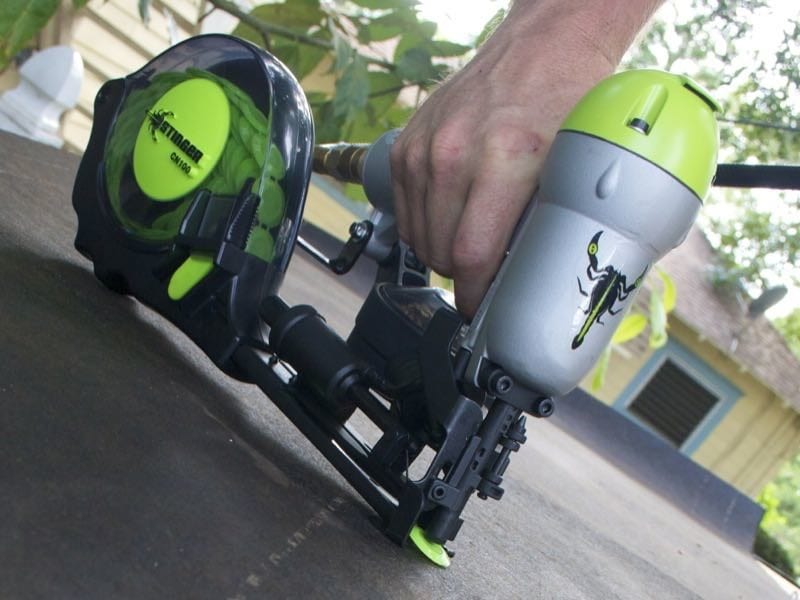
We got to check out a preview of National Nail Corp’s Stinger CN100B Cap Nailer at the 2011 International Builders Show. It impressed us—even before product manager, Rocky Stroud sent us one a year later for a proper review. In Central Florida, roofing is something you have to deal with regularly. It’s not exactly the most enjoyable form of employment—at least not in the summer.
When the humidity is at 98% and the sun is beating down on you in June, anything you can do to get off that roof more quickly is going to be music to your ears. The Stinger CN100B Cap Nailer is the brainchild of National Nail Corp, which is in the business of manufacturing high-quality fasteners for the commercial and residential construction markets. They also make the Camo Marksman Pro Hidden Deck Fastener system.
The Stinger CN100B speeds up the job of fastening underlayment, felt paper, or Tyvek-style house wrap. It does so while adhering to most local building codes that may not yet accept staples. The Stinger CN100B Cap Nailer should work just about anywhere. Miami-Dade, however, requires a (ridiculous, in our opinion) larger cap diameter of 1-5/8″ or greater.
Stinger CN100B Cap Nailer Build Quality and Features
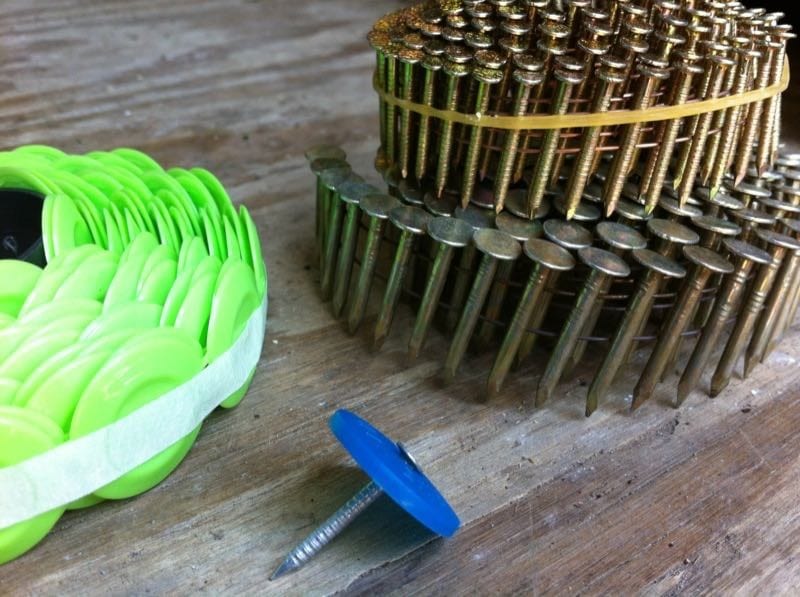
Right off the bat, we noticed a couple of things about the Stinger CN100B in comparison to some other cap nailers. First, for better or worse, it uses proprietary caps and 1″ ring shank electro-galvanized nails. These mimic, almost perfectly, the makeup of a traditional cap nail. Put these in and no inspector on the planet can legitimately cite you wherever 1-inch caps reflect code.
A NailPac carton of 2000 caps and electro-galvanized nails runs $57. It covers approximately 25 squares (2500 square feet—an average-sized home). For comparison, a bucket of 4000 cap nails retails for around $48. The difference is that you’re going to be out in the heat a LOT longer doing the job manually than if you use a pneumatic cap nailer like the Stinger CN100B.
Diminutive But Quick
But we said a “couple” of things were noticed, right? The second thing was size. The Stinger CN100B is much smaller than comparable systems we’ve seen on the market. And when we say smaller, we mean it weighs about half as much and takes up about half the space. The advantage here is that you’re not lugging about 9 pounds as you traverse the roof. Instead, you can nail down felt or secure house wrap carrying just five pounds. The only issue we felt could be a problem was that, with the light weight, came a bit of fragility.
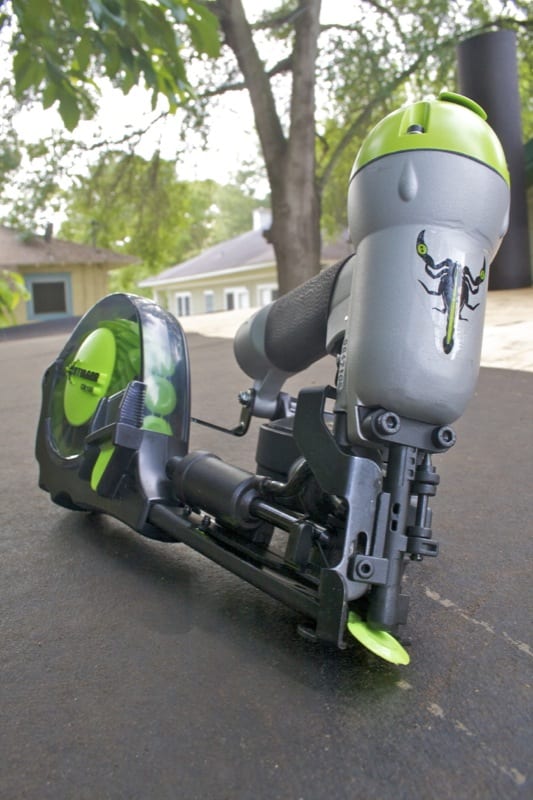
The Stinger is not a tool you want to drop to the ground from any sort of height. We’ve no doubt you’d need to repair the all-plastic cap feeder at the very least. Treat it carefully, however, and the weight savings just might be worth it. This is most definitely a fresh take on a much-needed tool. We can appreciate the design goal of a much more portable design.
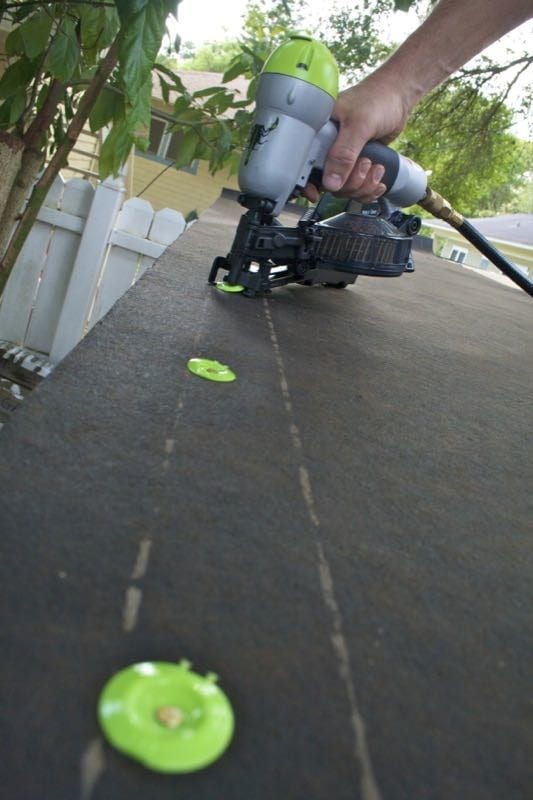
Stinger CN100B Cap Nailer On the Roof…
The tool itself was a comfortable fit for our hands. The rubberized overmold on the handle is nice and thick and doesn’t peel back, so it feels durable. The nails load as you’d expect, which is to say, easily and without any hang-ups. Since the tool only uses 1″ ring shank nails, there’s no height adjustment for the coil nail feeder mechanism. Contrast this to tools that use standard coil roofing nails. The caps load into the rear chamber. Simply flip open the lid, insert a NailPac spool, and feed it up to the front of the tool. All told it took less than 30 seconds to get everything loaded once we knew what we were doing.
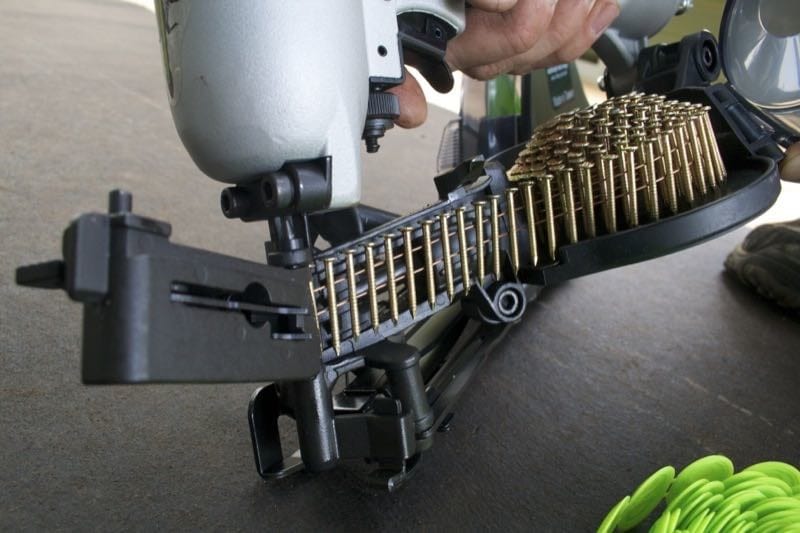
Loading Up the Tool
We used a Bosch CET4-20W 4-Gallon 2-HP Air Compressor to power the tool, and, with the tank loaded up to 120 PSI, we set the output pressure to 100 PSI. The tool initially drove the nails too far into the cap, splitting it. There is a mechanical depth adjustment in front of the trigger, but we found it very difficult (almost impossible in our sample, without the use of pliers) to adjust by hand.
In the end, turning down the PSI of the compressor’s output line to 90 PSI seemed to do the trick. A better depth adjustment mechanism would help this tool, particularly when you are driving more than one nailer off a single compressor and can’t vary the PSI output for just one tool.
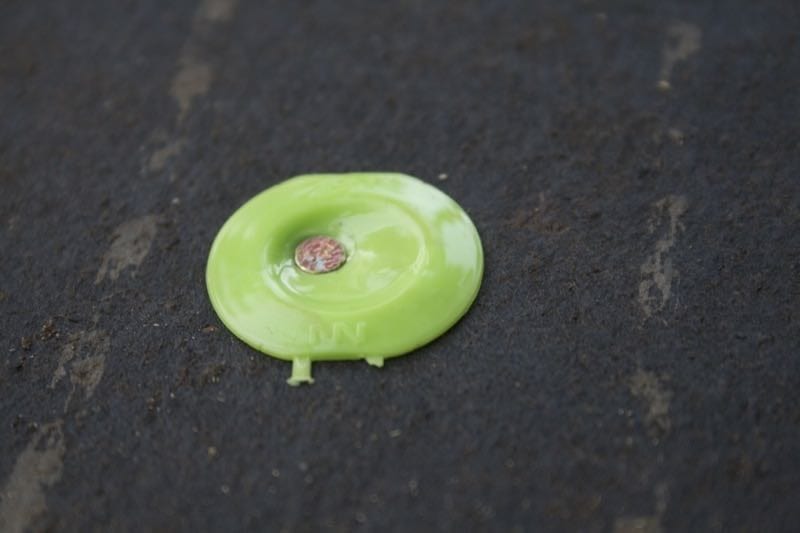
And then we really started to take off. With the lightweight nature of this tool, we found ourselves nearly running along the edges of our felt, securing it to the 1/2″ plywood below. OK, maybe we weren’t running, but the speed with which we could operate the tool was staggering. In the hot and humid Florida weather, this tool saved us untold amounts of time and energy. Once we had the air pressure set at the compressor, the tool consistently fired nails into the caps at the right depth.
There is no doubt in my mind that anyone, after using this tool, would throw away their manual roofing methods for a shot to speed up the process with the Stinger CN100B. And as we mentioned earlier, since the Stinger uses what is effectively a standard cap nail, there are hardly any issues with local building codes, save for the rather strict and contentious Dade County (which requires 1-5/8″ caps).
Stinger CN100B Cap Nailer Conclusion
We really liked using the National Nail Corp Stinger CN100B Cap Nailer. It’s a great tool. For those who prefer a more robust solution – and who don’t mind carrying around additional weight – there are likely tougher options. But if you want a fast tool that will take a load off your arms, this is worth a look – particularly if you use a cap nailer on vertical surfaces such as applying house wrap.
At just over $300 for the tool and a couple of hundred for nails, you can take it to your next job and give it a run for its money. We guess that you’ll be sold on it and end up making up a lot of time in the process. Given the current economy, every little bit helps. And in the summer, ample motivation exists to want to speed up your workflow!