
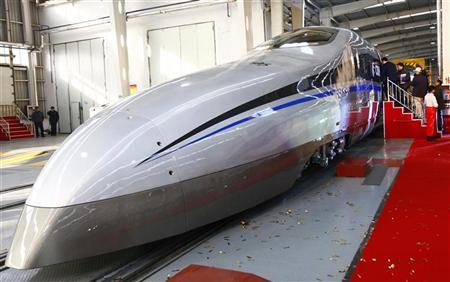
And I thought the Bugatti Veyron was fast! China has just unveiled its new “super-rapid” test train which is capable of traveling 310 miles per hour (500 kph). The reveal of the China 310mph bullet train, which took place over the weekend, is a positive move for the country that is suffering setbacks due to a fairly recent collision between two high-speed trains back in July. That crash killed over 40 people. Following the crash, the construction of new high-speed trains in China has since been a near halt… kind of like American trains have been since the dawn of the diesel engine…
China 310mph Bullet Train Details
Of course, if that weren’t enough, back in February Liu Zhijun, who functioned as China’s railway minister and a key figure responsible for the explosive growth in high speed trains in the country, was dismissed over corruption charges. While the charges haven’t yet reached the courts, it’s still a black mark on the industry as a whole.
The new China 310mph bullet train, which functions on principles of magnetic levitation (or mag-lev as it’s commonly referred to) is made by a subsidiary of CSR Corp Ltd, which is China’s largest train maker. The train is super cool-looking and extremely aerodynamic on the front and rear ends, being purposefully made to resemble an ancient Chinese sword.
Check it out here:
Of course, though this represents new speed capabilities in Chinese-made trains, the new 310 mph beast doesn’t necessarily spell the end of slower train designs (and we use the term “slower” very loosely, considering the relative snails pace of our existing trains). The reporting news agency stated that future Chinese trains will not necessarily run at such high speeds, according to CSR chairman Zhao Xiaogang. The goal, of course, is to ensure that all of the trains, including any newer, higher-speed models, run safely.
So maybe this wasn’t a power tool, but I can’t think of anything more appealing to a power-hungry, tool-wielding man than a train that can brag speeds of up to 500 kmph. The question is: will we ever get one in the United States, and develop the required infrastructure for it to make any sense?