When Festool invited us to visit their facilities in Germany, we thought it would be a great opportunity to gain a closer look at the workings that make this company so successful in designing and producing high-quality tools for the woodworking and automotive industries. The Festool Germany media event, however, was more than just getting to see the company; it was a chance to experience the culture and people that help make this company what it is today.
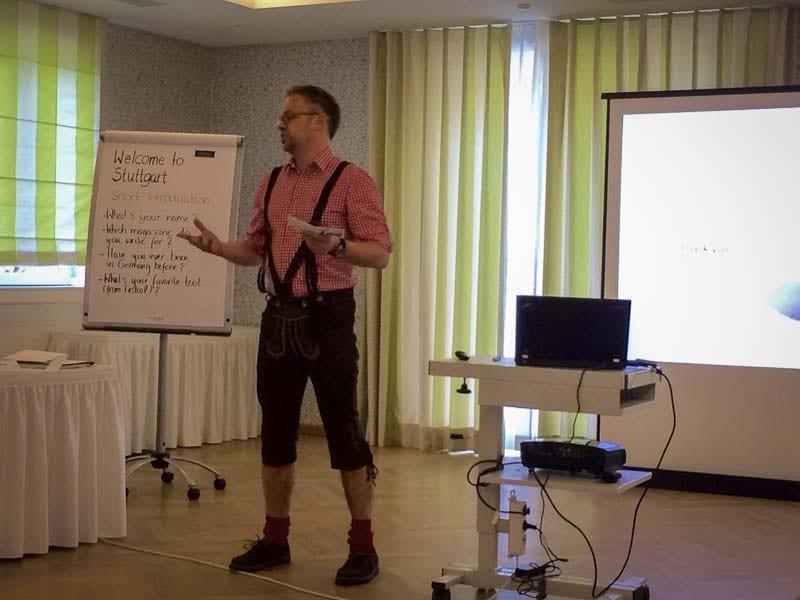
Our first stop was the hotel in Stuttgart (thankfully, after the long flight!). We settled in and were treated to a brief presentation on Festool. For those unfamiliar with Festool, the company was founded by Gottlieb Stoll and Albert Fezer in 1925 as Fezer & Stoll. The name has evolved slightly over the years (Festo in the 50s, Festo ToolTechnic in the 90s, and finally Festool), but the company has always maintained a very specific market geared towards professional tool users. Oddly enough, it wasn’t until the 1980s that Festool really started focusing on handheld power tools.
Brief Festool Timeline
- 1925 – Gottlieb Stoll founds Fezer & Stoll
- 1951 – Festo makes the first orbital sander
- 1993 – Festo Tooltechnic invents the systainer
- 2000 and onward – Festool releases the Domino, Kapex, Rotex, Carvex…
Festool remains a family owned company—in fact, Barbara Austel is currently a shareholder and granddaughter of Gottlieb Stoll. The Festool Group headquarters is in Wendlington and the company employs 2500 workers. There are three manufacturing sites in Germany (actually a full 80% of Festool’s tools are made in Germany.)
Getting Tools to Market
Attending the Festool Germany media event also allowed us to understand a little bit more about how Festool decides what tools to bring to market. Festool manufactures tools for specific target groups, including woodworkers (joiners), carpenters, painters, car body painters (surface prep), and remodeling/renovation/light construction. There’s a reason you don’t see tools for plumbers and electricians—they aren’t part of Festool’s target market.
From idea to market-ready, it takes Festool about 4 years to get a tool made. Festool’s approach is almost opposed to rapid deployment. Instead, the company employs long-term thinking. For Festool, a tool must be perfect (at least as much as can be expected)—their customers aren’t beta testers.
Their many policies also enforce this way of thinking. For example, each tool comes with a 3-year warranty with free shipping for repairs. They ensure a 10-year parts availability guarantee—so that the tool you bought three years ago will still be repairable in the future. Also, there’s a 48-hour repair turnaround and a 30-day money-back guarantee.
What’s Next…
Of course, not everything on this first day was serious information about the company. We were treated to a sneak peek at our attire for a Beer festival on Wednesday. Yes, everyone in the media group will be wearing honest-to-goodness Lederhosen!