
Within the last two months, Nexeon (an Oxfordshire-based research group) produced a record-breaking 18650 Li-ion cells with a capacity of 3.2Ah using its very own silicon anode technology. These Nanoscoop Lithium ion batteries recharge in 1 Minute!
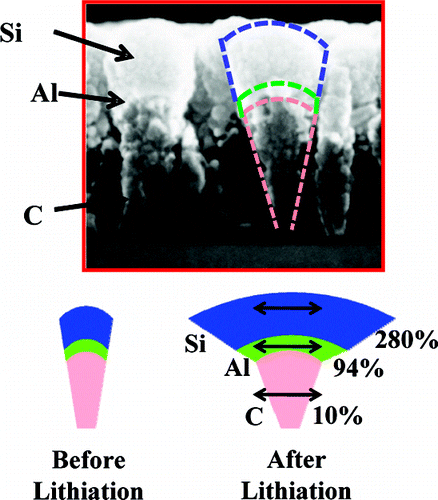
The team came up with a nanostructure they are dubbing a “nanoscoop” – and it really does resemble an ice cream cone (check out the photo). It’s made from a carbon rod base that has a thin layer of aluminum followed by a silicon layer. The scoops are apparently able to take on, and discharge, Li ions at extremely fast rates and without the expected damage. About how fast? A full 40-60x faster than existing technology.
What are Nanoscoop Lithium Ion Batteries?
OK, so what’s the catch? Well, there is a big one (sorry).
Scaling up the technology seems very difficult at present. The anode structure of a Li-ion battery physically grows and shrinks as the battery charges or discharges. So basically, the design of this new technology produces a lot of stress that renders it very difficult to increase the size of the scoops.
Ready to geek out? Here’s the official technical brief:
Lithium-ion batteries show poor performance for high power applications involving ultrafast charging/discharging rates. Here we report a functionally strain-graded carbon−aluminum−silicon anode architecture that overcomes this drawback. It consists of an array of nanostructures each comprising an amorphous carbon nanorod with an intermediate layer of aluminum that is finally capped by a silicon nanoscoop on the very top. The gradation in strain arises from graded levels of volumetric expansion in these three materials on alloying with lithium. The introduction of aluminum as an intermediate layer enables the gradual transition of strain from carbon to silicon, thereby minimizing the mismatch at interfaces between differentially strained materials and enabling stable operation of the electrode under high-rate charge/discharge conditions. At an accelerated current density of 51.2 A/g (i.e., charge/discharge rate of 40C), the strain-graded carbon−aluminum−silicon nanoscoop anode provides average capacities of 412 mAh/g with a power output of 100 kW/kg electrode continuously over 100 charge/discharge cycles.
Nanoscoop Lithium ion Batteries Recharge in 1 Minute…or So
What exactly is the problem? Well, when you add too much stress to the system the cell fabric deteriorates – and you lose charge capacity. Like, permanently.
The proof of concept is excellent, but it’s simply too small to be of any present use. With that said, the team is planning on growing longer scoops with greater mass. Another method is to figure out how to stack them to achieve greater density, this might even include figuring out how to “roll” the layers on flexible substrates.
We’re in. Bring me a battery that can recharge in 1 minute instead of 45 minutes, and I’m all over it. Just promise me you can do it without blowing anything, or anyone, up!