
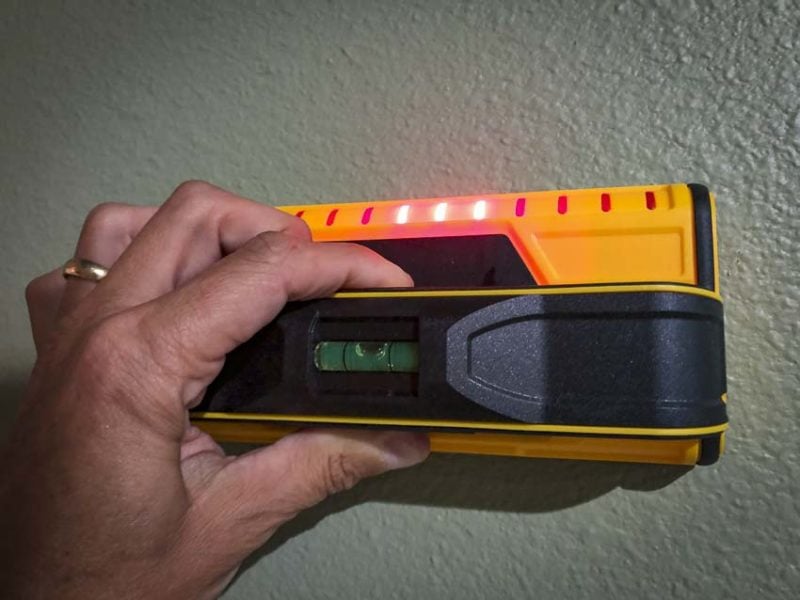
While advanced wall scanners exist, Franklin stud finders economically solve the problem of locating studs in a visual manner. The Franklin Sensors ProSensor 710 and the brand new ProSensor T13 use an array of 13 LED lights to instantly compare data across a full 7″ measurement scanning area. It detects anything within that area with minimal sliding across the wall. The result is fast stud finder scanning that seems more accurate. It also delivers definitive results more quickly than any stud finder we’ve yet used. It’s only a shame it took so many years to make a better “mousetrap”.
If you want something a bit more compact, check out the Franklin T6 stud finder for $25 which only uses 6 LED lights.
Editor’s Note: Check out our best stud finder article to get our top picks.
Franklin ProSensor Stud Finder Features
There isn’t much to the Franklin ProSensor T13 Stud Finder or the 710—at least not on the surface. Inside, I’m sure it’s doing all manner of evaluation and computations to deliver what ends up being stunningly accurate feedback on where studs (wood or metal) are located in a wall cavity.
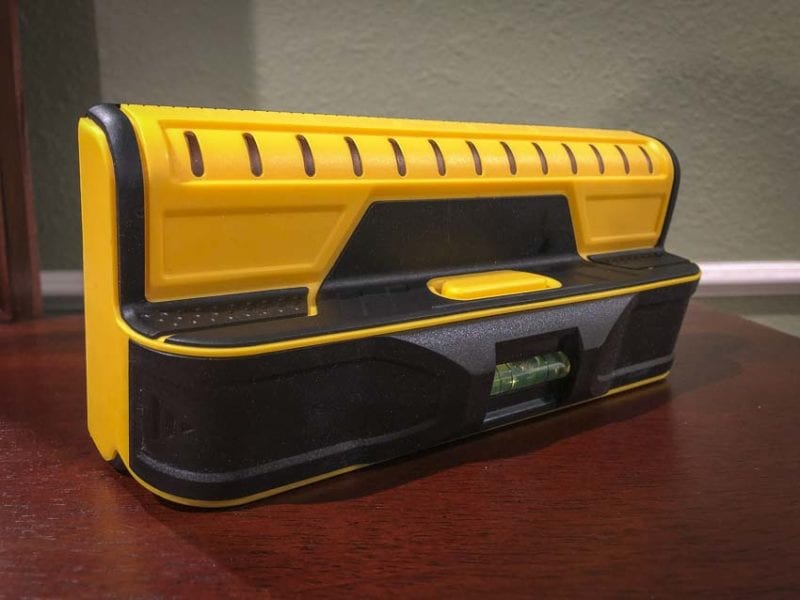
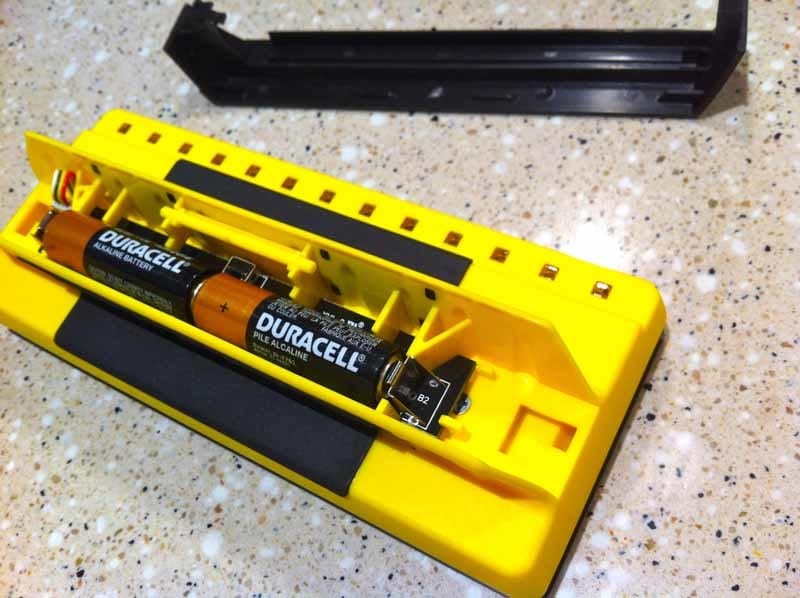
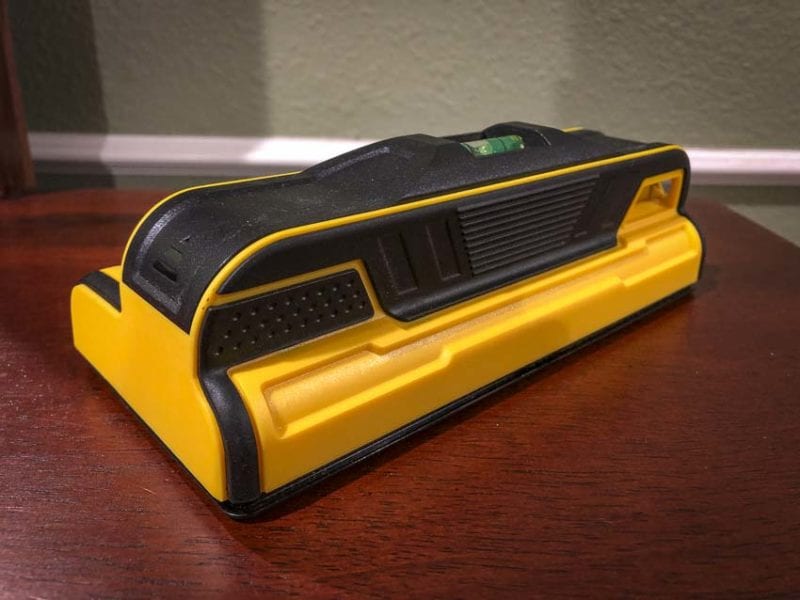
Physically, the 710 measures just under 7-1/8″ wide and less than 3″ tall. The Franklin T13 measures slightly longer at 7-3/8″ wide. It stands out from the wall about 1-7/8″ (2-1/4″ for the T13), less than an inch of that being the protruding handle, which extends across the entire width of the ProSensor. The handle has an indented plastic button which activates the unit and begins to instantly take readings from the embedded sensors, displaying the results on the 13-LED array at the top of the device. Both ProSensor models run off two AA batteries which fit neatly underneath the black cover on the top of the handle. The newer T13 uses a sliding deck which also houses an integrated bubble level.
For a smaller footprint, check out the Franklin Prosensor T6 stud finder ($25).
The tool is easy to place on a wall, but the handle, being so shallow, makes it a tad bit difficult to grasp comfortably. Designed to be positioned horizontally on the wall while you scan, the tool has a 90-degree shift from traditional stud finders like the Zircon MT6 MetalliScanner. If you really want “different” check out the simplistic but unconventional StudPop magnetic stud finders.
Interestingly, the Franklin T13 stud finder also includes a “pencil caddy” that lets you store a short pencil onboard for marking the wall when you’re hanging a picture on drywall or similar.
More Franklin Stud Finder Features
The Franklin Sensors ProSensor 710 and T13 stud finders have several key features which set it apart from the competition:
Aggregate Sensor Readings
Conventional stud finders can work very well, but they can also get confused by irregular wall textures and the general misreadings that occur when you start the sensor on a stud or run into an area where the wood and wall become less clearly defined – such as near windows, staircases, and doors. The ProSensor stud finders, on the other hand, use readings from several points on the wall at the same time. In fact, you get a full 7-inches worth of readings (13 in all) that combine instantly to pinpoint both wood and metal studs within a wall.
Detect 2 Objects Simultaneously
While a typical stud finder takes a single depth measurement in just one spot, the ProSensor 710 and T13 can actually detect up to two different objects simultaneously. This is great for when you’re trying to identify studs around light switches and other areas where stud proximity may be different than you find in a typical 16-inch-on-center straight wall layout.
Identify Object Widths
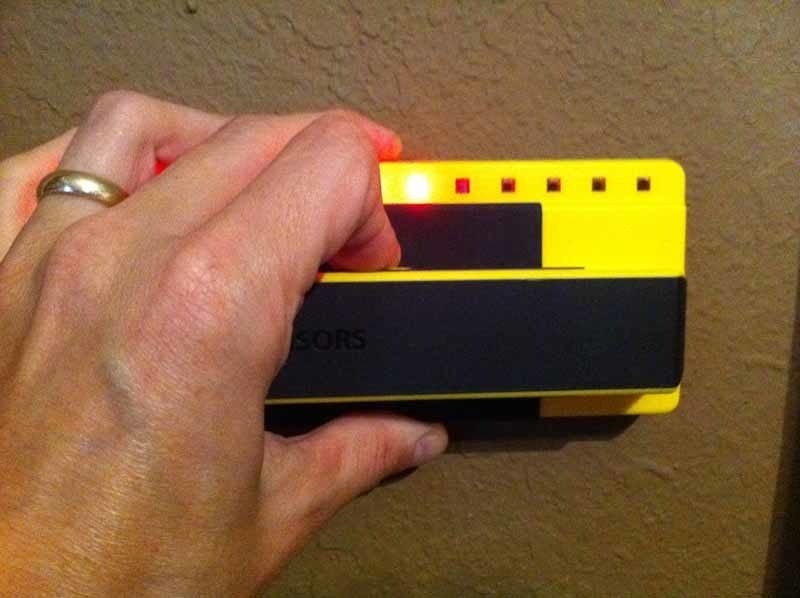
Ever wonder if you found a stud or something different? The Franklin stud sensors tell you the width of the object detected. Your typical stud measures 3 LEDs on the sensor and a facing stud will register as 6 LEDs. Since the ProSensors light up all of the LEDs in front of a hidden object, you always know the width of the object behind the wall.
Deep Scanning
Most stud finders are designed to work with one layer of sheetrock. The Franklin ProSensor 710 and T13 stud finder can handle up to 2 sheets, letting you scan through thicker walls up to 1.5 inches to locate studs (The T13 actually detects up to 1.7 inches). If you’re wondering why scanning through two layers of drywall may be important, realize that more and more homeowners are looking for inexpensive ways to better insulate their rooms from external sound and increase their wall’s noise reduction (NRC) rating. Of course, as it turns out, doubling up on drywall is a complete waste of time, but that’s another article.
Instant Detection
Turn it on and it works. Most stud finders need to be dragged across the wall for best performance. Some need to be “trained”. Since the ProSensor stud finders take multiple readings simultaneously, they’re ready to go right away, every time. No sliding, no waiting.
Field Testing and Use
These are stud sensors, so to test them we located many studs in a variety of locations. We got flawless results with 5/8″ drywall—even with heavily painted and textured walls. The ProSensors consistently located wood studs. They even handled corners and wall space next to doorways well, which surprised us. The sensors were easy to use and didn’t have a learning curve. We loved how fast the tools responded. We almost never had to move them around to get an accurate reading.
As you may imagine, these tools aren’t perfect. They can’t for example, detect studs underneath plaster and lath with the same precision they do with drywall. Of course, we didn’t expect them to. On several occasions they pointed out some studs that corresponded with known stud locations behind plaster/lath walls. We’d just consider that a bonus and counsel potential buyers to not count on that level of accuracy in that application.
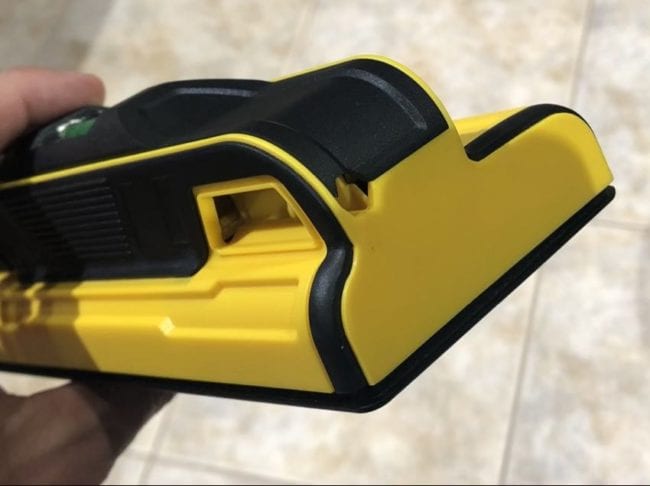
About the only thing we didn’t particularly like was the grip. It’s awkward since the handle only protrudes about 7/8″ from the base. This makes it a “fingertip” device that isn’t terribly ergonomic. With that said—we’re not sure how exactly you’d redesign this type of tool—and the benefits certainly outweigh this little niggle. Our “workaround” was to just grab the unit on the top and bottom and use our index finger to activate the button. Franklin Sensors cautions, however, that holding the unit in this way can interfere with the scanning if your fingers get too close to the wall, and thus the scanning array.
Conclusion
With a street price of $55 for the 710 and $59.99 for the T13, this isn’t the cheapest stud sensor. It doesn’t detect electricity or distinguish between ferrous and non-ferrous metals. What it does is find studs. Easily. Quickly. Consistently.
If you want a dependable product for accomplishing that task, something that should last a good long time and which won’t frustrate you with false positives, then one of the Franklin ProSensors is your tool. We loved them and wouldn’t mind seeing more products from this company.