
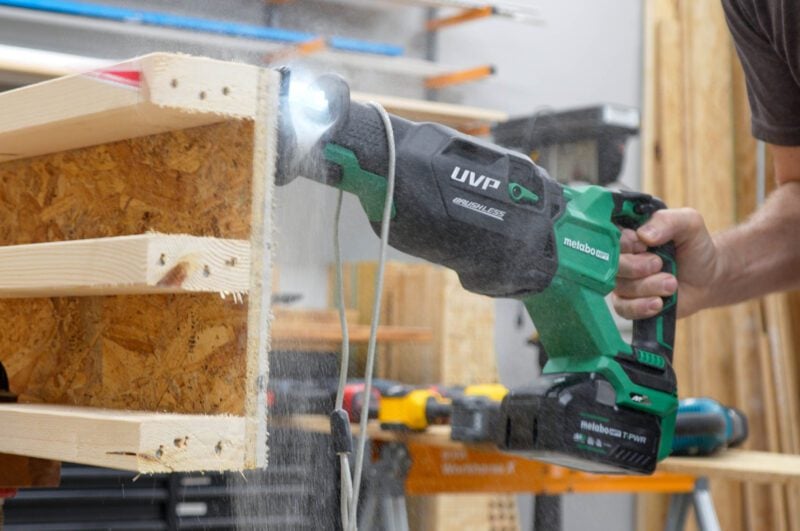
Metabo HPT MultiVolt Reciprocating Saw Challenges Milwaukee’s Dominance
We tested eleven flagship reciprocating saws head-to-head from the top brands in power tools. Today, we’re taking a look at one saw that may surprise you with its results—the Metabo HPT MultiVolt Reciprocating Saw. I’m going to walk you through the key highlights of this saw, show you how it fared in our testing, and compare it against competing models so you can decide if it’s the right tool for your next project.
Read
Best Cordless Reciprocating Saw Head-to-Head Review
Pros
- Excellent overall cutting performance
- Top-tier wood cutting performance
- Outstanding vibration control
- Available AC adapter for corded operation
- Lifetime warranty
Cons
- Heavier than average
- Shaft-mounted blade release
Metabo HPT 36V Reciprocating Saw Performance
- Max Stroke Rate Range: 1,700 – 3,000 SPM
- Stroke Length: 1.25 in.
- Orbital Action: Yes
Performance Basics
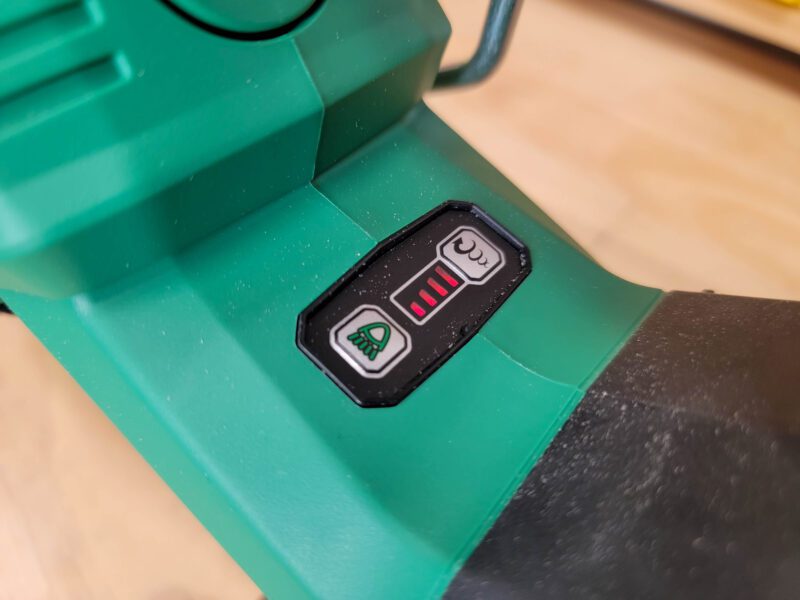
Metabo HPT gave this saw a 4-speed brushless motor that tops out at 3,000 SPM stroke rate with a 1 1/4-inch stroke length. When you want slower speeds, you can step the motor all the way down to 1,700 SPM. Of course, you can always feather the trigger to adjust your speed on the fly as well.
| Speed Mode | Strokes Per Minute |
|---|---|
| Low | 1,700 SPM |
| Medium | 2,000 SPM |
| High | 2,500 SPM |
| Max | 3,000 SPM |
These numbers are right in line with what we expect from a top-tier Pro-grade saw and give us high hopes for a solid performance during our hands-on testing (more on this later).
Orbital Action
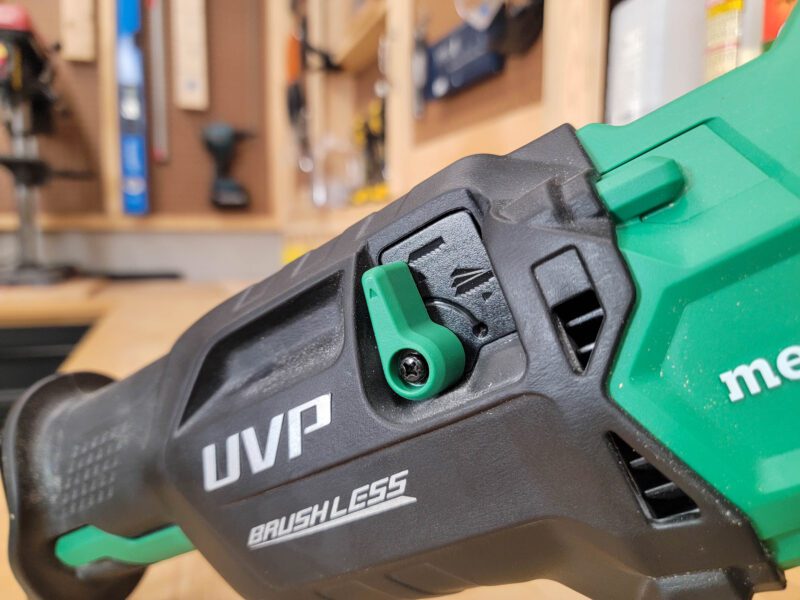
When we talk about cutting speed on reciprocating saws, we have to talk about orbital action. It makes a tremendous difference when you’re cutting wood.
Metabo HPT includes it, and this saw has a simple on/off lever to switch modes easily. I’ll show you what that meant in our wood-cutting tests in a moment.
Read
What is Orbital Action on a Reciprocating Saw and Do You Need It?
Vibration Level
Solid cutting performance sometimes sacrifices vibration control to achieve it, but that’s certainly not the case for Metabo HPT. The design team incorporated UVP (User Vibration Protection) into the saw. We appreciate any advancements in vibration control, and most brands include some form or another on their flagship saws. Still, some are better than others. That’s why we test.
Our team independently spent time working with each saw in our head-to-head, and the CR36DA scored top points right alongside the Makita 40V max XGT GRJ02. That’s very elite company to be in.
If the cutting speed on paper holds up, that plus such low vibration is a one-two punch that could vault it into serious contention.
Read
Reducing Vibration in Reciprocating Saws
Metabo HPT 36V Reciprocating Saw Battery Selection
Before we jump into our test results, I want to talk about our battery selection for testing. We opted for the new tabless T-PWR MultiVolt 4.0Ah battery because it delivers the best performance Metabo HPT offers without requiring an overly bulky and heavy pack.
The smaller 2.5Ah battery shaves off about 1/2-pound from the total weight, which is helpful if you’re working overhead. In most cases, the higher capacity of the 4.0Ah battery is the way to go. If you have the T-PWR pack, it’s even better since you get a performance boost.
That said, Metabo HPT has another slick trick up its sleeve…
Battery or AC Power
One of the defining features of the entire MultiVolt line is the ability to use the tools with either a battery or an AC adapter. For a heavy-duty reciprocating saw like this one, it’s a really helpful option.
You can use the AC adapter for an unending power supply when you’re on the ground and when it’s convenient. If you’re working at height, where having a cord gets in the way, or a long way from a power source, simply switch over to battery power.
As of now, Metabo HPT is the only brand offering this hybrid feature across the entire platform. Flex has an AC adapter for its 24V system, but it’s only designed for their table saws and miter saw.
Testing the Metabo HPT 36V Reciprocating Saw Head-to-Head
For our head-to-head testing, we ran this saw through a series of four tests ranging from light-duty cutting to serious demo work.
You can see the full details of each test on our main head-to-head page (linked here), but here’s a quick overview of what we put these saws through:
PVC Cutting
- Material: 4-inch, schedule 40 PVC pipe
- Blade: Milwaukee 9-inch Torch Thick Metal
- Downforce Control: 5-lb weight
- Mode: Full speed, orbital off
- Result: Average of three cuts
Undoubtedly, cutting 4-inch schedule 40 PVC pipe is the easiest test we put our saws against. The Metabo HPT averaged 2.85 seconds, landing it in second place right behind the Makita XGT’s 2.79-second average.
Finishing just 0.06 seconds behind the leader is impressive in its own right. But consider that the average time was 3.88 seconds. It’s only a little over a second, but in a test this fast, Metabo HPT was more than 25% faster than the group average.
Clean Wood Cutting
- Material: 2 x 12 dried yellow pine lumber
- Blade: Milwaukee 5 TPI, 9-inch Carbide Ax for Wood with Nails
- Downforce Control: 5-lb weight
- Mode: Full speed, orbital on
- Result: Average of three cuts
Next, we transitioned into a more demo-related application that requires a little more power by cutting clean 2 x 12 lumber.
The CR36DA averaged 8.23 seconds, once again landing it in second place, only this time it was behind Milwaukee’s M18 Fuel Super Sawzall, which had an impressive time of 8.18 seconds. Notably, in this case, Makita was our third-place finisher with an average time of 8.29 seconds.
Again, look at the gap. Metabo HPT was just 0.05 seconds behind the leader. The group’s average was 10.13 seconds. With nearly 19% faster cutting, the seconds start adding up.
Wall Cutting
- Material: Three 2 x 4 studs with three nails in each (nine nails total), 7/16-inch OSB, Hardie board siding
- Blade: Milwaukee 6 TPI, 9-inch Nitrus Carbide Wrecker for Multi-Material
- Downforce Control: 5-lb weight
- Mode: Full speed, orbital on
- Result: Average of three cuts
Upping the intensity, we set up a mock wall that includes a mix of common materials you’re likely to encounter. The idea behind this “wall sandwich” is that it provides a consistent medium that’s designed to give each saw a fair shake.
Once again, Metabo HPT took second place with a time of 18.11 seconds behind Milwaukee’s time of 18.05 seconds. Following right hind them (again) is Makita’s GRJ02, which posted 18.58 seconds.
At the risk of sounding like a broken record, check the gap—just 0.06 seconds behind the lead. Through three rounds of testing, Metabo HPT was just a total of 0.12 seconds behind the first-place finishers. That’s seriously elite performance!
As for the group average, it was 27.28 seconds, meaning Metabo HPT had a massive 33% advantage over the average finish time.
Cast Iron Pipe Cutting
- Material: 3-inch cast iron pipe
- Blade: Milwaukee 8 TPI, 9-inch Nitrus Carbide Torch for Thick Metal and Cast Iron
- Downforce Control: Hand control
- Mode: Full speed, orbital off
- Result: One successful cut
Rounding out our tests, we have the daunting cast iron cut. Cutting cast iron with a reciprocating saw isn’t for the faint of heart, yet in some parts of the country, it’s still a common demo occurrence.
On this go-around, Metabo HPT finished in 54.54 seconds, falling behind Milwaukee (41.54 seconds) and Makita (41.24 seconds) by a more significant margin.
We don’t see this as a knock against the CR36DA as there were a few models that exceeded a minute and one that wasn’t able to make the cut at all. Rather, it’s a testament to the difficulty of this particular task, and completing it in under 60 seconds deserves some recognition.
However, this was the one test that Metabo HPT wasn’t able to keep in close contact with the leaders on. Still, the average finish time was 59.31 seconds, so this saw was still ahead of the curve.
Metabo HPT 36V Reciprocating Saw Design Notes
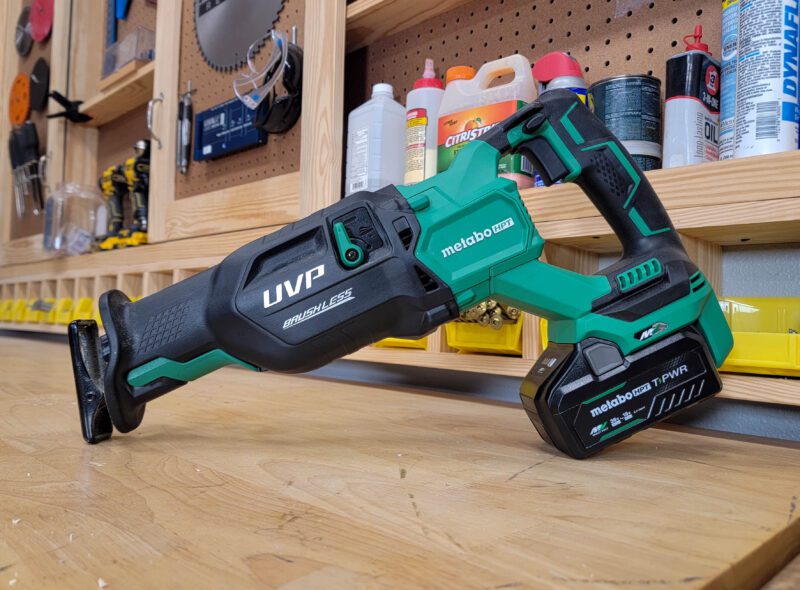
- Model: Metabo HPT CR36DA
- Power Source: Metabo HPT MultiVolt battery or 120V AC adapter
- Weight: 8.7 lbs (bare tool), 10.8 lbs (with 4.0Ah battery)
- Length: 18 in.
Size and Weight
The Metabo HPT CR36DA weighs 8.6 pounds as a bare tool, and jumps to 10.76 pounds with a 4.0Ah battery in place.
This is one of the heavier saws we tested in our roundup, but it’s still over a pound lighter than the monster Milwaukee M18 Fuel Super Sawzall! It’s also well within range of other premium models like the DeWalt DCS389, Bosch GSA18V-126, and the Makita GRJ02.
Saws on the lighter end of the scale weren’t able to keep up, offering evidence that if you want genuinely high performance, there’s a weight penalty in the reciprocating saw world.
As for length, this saw measures 18 inches from tip to tail, easing in closer to the middle of the pack, which ranged from 15.25 inches for the most compact to 18.75 inches for the longest.
Metabo HPT designed the front housing to be thinner than a lot of the competition. Our testing team is in agreement that it offers a more comfortable grip when you’re cutting, especially if your hands are on the smaller side.
On top of that, the main body of the saw and rear grip section are draped in a generous amount of rubber overmolding for added protection and comfort.
Blade Changes
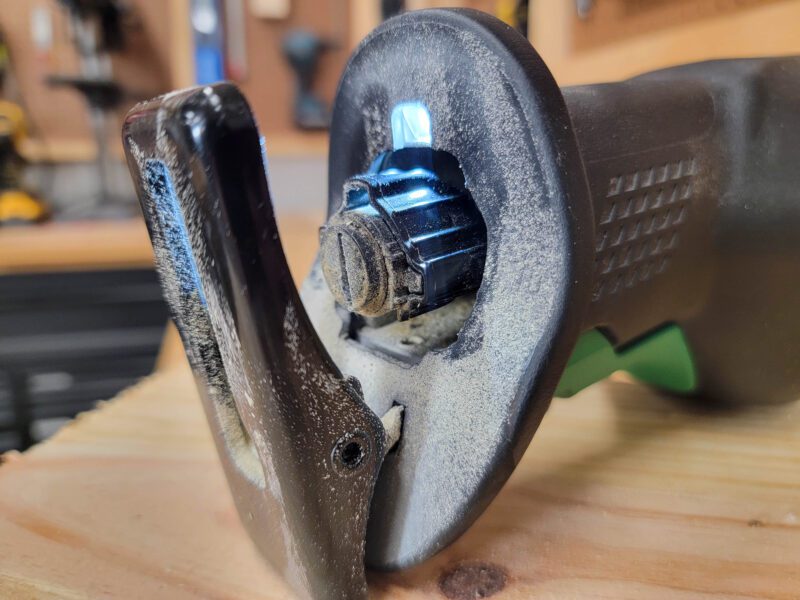
Swapping blades is a little tedious since the CR36DA doesn’t feature an external release lever or a spring-loaded ejection mechanism. Rather, the blade release is located on the blade shaft and requires a quarter turn to release the blade from the collet.
It’s not a deal-breaker, and Metabo HPT isn’t the only brand to embrace this design. But if you don’t want to get your fingers too close to the action or simply prefer an easier mechanism, look for a model that positions the release lever on the side of the tool.
Additional Features
- Variable Speed Dial: Adjust the cutting speed by feathering the trigger
- Adjustable Shoe: Extend the shoe tool-free to use different teeth on your blade and extend its life
- Pivoting Shoe: Helps maintain contact with material to reduce overall vibration, especially on long or round cuts
- Rafter Hook: Set the saw on a rafter, ladder rung, or other material when you need both hands for something else
- LED Light: Lights up the space immediately in front of the saw so you can better see what you’re cutting
Metabo HPT 36V Reciprocating Saw Price
As a bare tool, you can snag the Metabo HPT CR36DA for $199, and the kit retails for $399. The kit includes a 4.0Ah MultiVolt battery, charger, and a storage bag. You can also pick up the AC adapter for $119.
Metabo HPT has a limited lifetime warranty on its lithium-ion tools, including this saw.
Should You Buy It?
The Metabo HPT MultiVolt reciprocating saw is one of the only models we tested that can seriously give Milwaukee a run for it’s money in the cordless super saw class. We’re genuinely impressed with its design and cutting performance, and its class-leading vibration control is a welcome relief to our arms.
The takeaway from all of this is that the Metabo HPT MultiVolt reciprocating saw is an excellent choice when your demo work calls for cutting a variety of materials. Between wood, metal, and mixed materials, we’re not disappointed by its cutting speed in any of them.
On top of that, we crowned the CR36DA as our second-place finisher after our latest batch of head-to-head testing. Given the testing results and the fact that this Pro-grade saw sports a very attractive price tag, it’s another compelling reason to consider Metabo HPT’s 36V platform as your primary system.